Shopify and GoHighLevel get pitted against each other constantly, but they are built to solve very different problems.
Shopify is a dedicated ecommerce platform for running an online store, while GoHighLevel is an all-in-one CRM and marketing automation suite aimed at agencies and service businesses that also happens to include some selling features.
After spending more than 80 hours testing both platforms across pricing, selling features, automation, and ease of use, our short answer is this: if your goal is to sell products online, Shopify wins comfortably. If your goal is to manage leads, funnels, and client relationships at scale, GoHighLevel is the stronger pick.
The more useful question for most readers is not “which one is better” but “which one fits what I am actually trying to do,” and in plenty of cases the smartest move is to run both together.
Below, I break down where each platform pulls ahead, where it falls short, and how to decide.
Shopify vs GoHighLevel: Quick Verdict
Top pick for ecommerce: Shopify, best for selling physical and digital products with a scalable storefront (first 3 months for $1/month on paid plans).
Top pick for automation: GoHighLevel, best for CRM, funnels, and marketing automation, especially for agencies and service businesses.
In this comparison, I look at why these two tools rarely compete head to head, where each one genuinely earns its place, and when pairing them beats choosing just one.
Quick Comparison: Shopify vs GoHighLevel
Get a fast overview of how the two platforms stack up before we dig into the detail:
| Feature | Shopify | GoHighLevel |
|---|---|---|
| Best for | Selling products online | CRM, funnels, and automation |
| Starting price | $29/month (Basic, billed annually) | $97/month (Starter) |
| Free trial | 3-day trial plus $1/month intro deal | 14-day trial, no card required |
| Selling physical products | Excellent (native, full stack) | Basic (better for digital and funnels) |
| CRM and sales pipelines | Limited (apps needed for depth) | Excellent (built in) |
| Funnels and automation | Good via apps (Klaviyo, etc.) | Excellent, multi-step and native |
| Email and SMS | Shopify Email plus apps | Native email, two-way SMS, calls |
| Multiple brands / white-label | One store per plan | Sub-accounts and white-label |
| Transaction fees | 0% with Shopify Payments (card rates apply) | No platform transaction fee (usage fees apply) |
| Ease of use | Quick, guided setup | Powerful but steeper learning curve |
Key Takeaways
- They are not really rivals. Shopify is a commerce engine, GoHighLevel is a revenue operations and automation hub. Choosing between them usually comes down to whether your business is product-led or service-led.
- Shopify is cheaper to start at $29/month and is purpose-built for catalogs, checkout, inventory, and multichannel selling.
- GoHighLevel gets more cost-efficient once you manage multiple brands or client accounts, thanks to sub-accounts and white-label tools on its higher plans.
- The hybrid stack is increasingly common: keep Shopify as the storefront and connect GoHighLevel for CRM, post-purchase funnels, and lifecycle automation.
Shopify vs GoHighLevel: How Pricing Compares
Because these platforms target different jobs, comparing their price tags directly can be misleading. Shopify is cheaper at the entry level, while GoHighLevel’s pricing only makes sense once you value the CRM and automation it bundles in.
Shopify pricing
Shopify has three core plans, billed annually, plus a lightweight Starter option and an enterprise tier:
- Starter, $5/month: checkout links and social selling, not a full store.
- Basic, $29/month annually ($39 monthly): a full store with unlimited products, abandoned cart recovery, and 2.9% + 30c per online card transaction.
- Grow, $79/month annually ($105 monthly): lower card rates, standard reports, advanced inventory tools, and up to 5 staff accounts.
- Advanced, $299/month annually ($399 monthly): the lowest card rates (2.5% + 30c), custom reporting, and up to 15 staff accounts.
- Plus, from $2,300/month: enterprise features for high-volume and B2B brands.
New merchants can claim their first 3 months for $1/month on paid plans, and there is a short 3-day free trial. If you use Shopify Payments you avoid extra transaction fees, though standard card processing rates still apply.
GoHighLevel pricing
GoHighLevel runs on three plans, with usage-based charges for SMS, email, calls, and AI billed on top:
- Starter, $97/month (about $81 annually): the full CRM, funnel builder, email and SMS, and calendars, with up to 3 sub-accounts.
- Unlimited, $297/month (about $248 annually): unlimited sub-accounts, white-label options, and API access.
- Agency Pro (SaaS mode), $497/month (about $414 annually): the ability to resell the platform as your own branded software.
There is a 14-day free trial with no credit card required, which is more generous than Shopify’s 3-day window. The catch is that messaging and AI usage fees can add anywhere from $20 to $150+ per month depending on volume, so the sticker price is rarely your true cost.
| Plan | Shopify | GoHighLevel |
|---|---|---|
| Entry plan | $29/month (Basic) | $97/month (Starter) |
| Mid plan | $79/month (Grow) | $297/month (Unlimited) |
| Top plan | $299/month (Advanced) | $497/month (Agency Pro) |
| Enterprise | Plus from $2,300/month | Custom / SaaS reselling |
| Free trial | 3 days | 14 days |
| Usage fees | Card processing only | SMS, email, calls, AI billed separately |
The Winner: It depends on your model
For a single product-led brand, Shopify is far cheaper to launch and scale. For an agency or operator juggling several brands or client accounts, GoHighLevel’s sub-accounts and white-label tools make it the better value despite the higher headline price.
Best for Selling Products Online: Shopify

This is the category Shopify was built for, and it shows. Shopify gives you a complete ecommerce stack out of the box: product catalogs, collections, inventory management, shipping and tax configuration, discount codes, and full order management are all native.
It also handles multichannel selling, letting you sell through your online store, marketplaces like Amazon and Etsy, social platforms, and in person via POS.
On top of that sits an app marketplace with thousands of integrations for upsells, subscriptions, reviews, and print-on-demand, so you can extend the store without custom development.
GoHighLevel did add ecommerce functionality, but reviewers consistently describe it as more basic for pure online selling. Its commerce strengths show up in funnels (order forms, upsell and downsell pages), digital products, memberships, and course delivery rather than large, catalog-driven stores with complex inventory and physical logistics.
Where Shopify pulls ahead
- Native inventory, shipping, tax, and order management for physical products
- Multichannel selling across web, marketplaces, social, and retail POS
- A deep app ecosystem for almost any selling feature you need
- Built to scale from a first sale to high-volume enterprise
Where it falls short
- CRM and sales-pipeline tooling is thin without third-party apps
- Advanced automation often means paying for extra apps
The Winner: Shopify
For anyone selling physical or digital products at any real scale, Shopify’s purpose-built commerce engine is the clear choice. GoHighLevel simply is not designed to run a catalog-driven store.
Best for CRM and Sales Pipelines: GoHighLevel
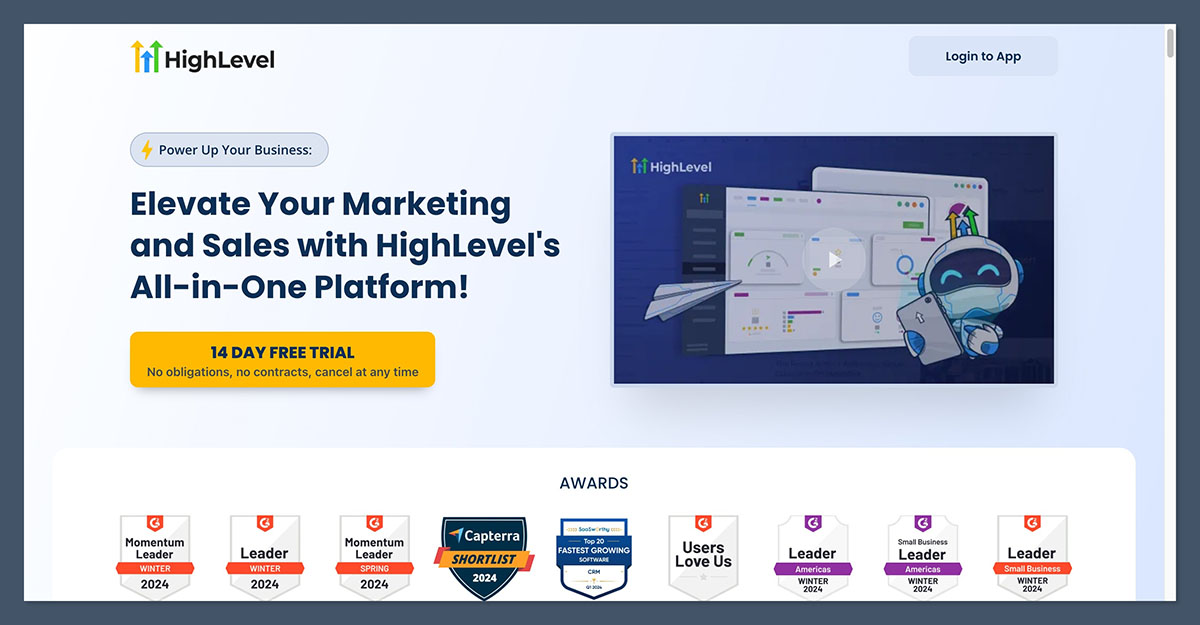
Here the roles flip. GoHighLevel is built as a unified CRM and automation hub, and it bundles tools that Shopify only offers in a stripped-back form.
Out of the box you get visual sales pipelines, detailed contact records, lead scoring, booking and calendars, call tracking, and reputation management, all inside one environment. That makes it well suited to businesses that need to nurture leads over time and manage relationships across many touchpoints.
Shopify, by contrast, gives you basic customer profiles, order history, and a handful of native marketing flows like abandoned cart emails. It is perfectly capable for ecommerce-centric follow-up, but its CRM depth and pipeline tooling are limited next to a dedicated platform. Most serious Shopify stores reach for an app like Klaviyo to close that gap.
The Winner: GoHighLevel
If managing leads, pipelines, and long sales cycles is central to your business, GoHighLevel’s built-in CRM beats anything Shopify offers natively.
Best for Funnels, Automation, and Lead Nurturing: GoHighLevel
GoHighLevel’s signature strength is automation. It ships with multi-step visual workflows, email campaigns, two-way SMS, voicemail drops, and booking, so you can build lifecycle journeys that move a contact from first touch to repeat customer across multiple channels.
It also includes funnel and landing page builders aimed at order forms, upsells, memberships, and courses, which is why service businesses and digital product sellers gravitate toward it.
Shopify can absolutely do strong automation, but it leans on apps to get there. Tools like Klaviyo and Omnisend integrate cleanly and are excellent for ecommerce email and SMS, yet that is an added layer (and an added cost) rather than something native to the core platform.
Where GoHighLevel pulls ahead
- Native multi-step automation across email, SMS, calls, and DMs
- Built-in funnel, landing page, membership, and course tools
- Everything lives in one dashboard, reducing app sprawl
Where it falls short
- The breadth of features means a real learning curve
- Messaging and AI usage fees stack on top of the plan price
The Winner: GoHighLevel
For advanced, cross-channel automation and funnels without bolting on extra apps, GoHighLevel is the more complete tool straight out of the box.
Best for Agencies and Managing Multiple Brands: GoHighLevel
If you run marketing for several businesses, or operate multiple brands yourself, GoHighLevel’s architecture is hard to beat. Its sub-account structure and white-label tools let you give each client (or brand) its own portal, automations, and reporting under your own branding.
The Starter plan supports up to 3 sub-accounts, Unlimited removes the cap and adds white-label and API access, and Agency Pro lets you resell the platform as your own SaaS product. That model is exactly why agencies adopt it.
Shopify, in comparison, is built around running one store per plan. Agencies serving ecommerce clients typically build each store on Shopify and plug in specialized tools rather than consolidating everything into a single account.
The Winner: GoHighLevel
For agencies and multi-brand operators, GoHighLevel’s sub-accounts and white-label options are purpose-built for managing many businesses under one roof.
Best for Ease of Use and Getting Started: Shopify
Shopify is designed so a non-technical owner can launch a store quickly. Onboarding asks a few simple questions about your business, then drops you into a clean dashboard with a guided setup checklist. Adding products, choosing a theme, and configuring payments are all approachable on day one.
GoHighLevel is more powerful, but that power comes with complexity. Because it covers CRM, funnels, automation, messaging, and agency tooling, the dashboard has far more surface area, and most users report a setup period of a couple of weeks before things click. For a solo owner who just wants to sell, that can feel like a lot.
The Winner: Shopify
For speed to launch and a gentle learning curve, Shopify is friendlier, especially for first-time store owners. GoHighLevel rewards the time you invest, but it asks for more of it.
Using Shopify and GoHighLevel Together
The most practical takeaway is that you often do not have to choose. A growing share of operators run Shopify as the storefront and connect GoHighLevel for CRM and automation.
GoHighLevel offers a native Shopify integration that syncs customer and order data into the CRM, so you can run post-purchase campaigns, abandoned cart sequences, and lifecycle automations from the marketing side while Shopify handles catalog, checkout, and fulfillment.
Practitioners do note the integration can feel a little clunky, and it works best when you keep clear role separation: Shopify owns commerce, GoHighLevel owns relationships and automation.
Think of it as two operating systems working in tandem:
- Shopify-only: straightforward direct-to-consumer stores that mainly need a great storefront.
- GoHighLevel-only: agencies and service businesses built around leads, bookings, and funnels.
- Shopify plus GoHighLevel: product brands that want advanced CRM and automation layered on top of a serious store.
If you are considering going the other direction, GoHighLevel does publish migration documentation for bringing Shopify data into its environment.
That move makes sense when unified automation matters more than Shopify’s native commerce ecosystem, but most ecommerce operators keep Shopify as the storefront and offload only CRM and automation.
How We Compared Shopify and GoHighLevel
Because these platforms serve different jobs, we weighted our testing around the outcomes each is hired to deliver, then assessed how well each tool performs against both:
| Criteria | Weight | What we assessed |
|---|---|---|
| Ecommerce and selling | 25% | Catalog, checkout, inventory, multichannel, and POS |
| CRM and automation | 25% | Pipelines, workflows, email, SMS, and lead nurturing |
| Pricing and value | 15% | Entry cost, scaling cost, and total cost of ownership |
| Ease of use | 15% | Onboarding, dashboard clarity, and time to launch |
| Integrations and ecosystem | 12% | App marketplaces, native integrations, and extensibility |
| Support and resources | 8% | Help channels, documentation, and learning materials |
We spent hands-on time inside both platforms, building a test store in Shopify and a test pipeline and funnel in GoHighLevel, so the recommendations reflect real use rather than spec sheets alone.
Shopify vs GoHighLevel: Our Verdict
There is no single winner here, because Shopify and GoHighLevel are not really competing for the same job. The right call depends entirely on what your business is built around.
Choose Shopify if you sell physical or digital products and want a scalable, easy-to-launch storefront with strong commerce features and a deep app ecosystem. It is cheaper to start, simpler to learn, and unmatched for catalog-driven selling.
Choose GoHighLevel if your business runs on leads, bookings, and relationships, or if you are an agency managing multiple clients. Its native CRM, automation, funnels, and white-label tools do work that Shopify cannot match natively.
And if you are a product brand that has outgrown basic ecommerce email, consider running both: keep Shopify as your commerce engine and add GoHighLevel as your automation and CRM layer. For many growing stores, that hybrid stack delivers more than either tool can alone.
Frequently Asked Questions
Is GoHighLevel an ecommerce platform like Shopify?
Not really. GoHighLevel has added some ecommerce features, but it is fundamentally a CRM and marketing automation platform. Shopify is a dedicated ecommerce engine built for catalogs, checkout, inventory, and multichannel selling, which makes it the stronger choice for running an actual online store.
Which is cheaper, Shopify or GoHighLevel?
Shopify is cheaper to start, with a Basic plan at $29 per month versus GoHighLevel’s $97 per month Starter plan. GoHighLevel can become better value if you manage multiple brands or client accounts, since its higher plans include sub-accounts and white-label tools. Remember that GoHighLevel adds usage fees for SMS, email, and AI on top of the plan price.
Can you use Shopify and GoHighLevel together?
Yes. GoHighLevel offers a native Shopify integration that syncs customer and order data, so you can run post-purchase campaigns and lifecycle automations from GoHighLevel while Shopify handles the storefront, checkout, and fulfillment. It works best when Shopify owns commerce and GoHighLevel owns CRM and automation.
Should an agency choose Shopify or GoHighLevel?
For agencies managing marketing, leads, and client portals across multiple businesses, GoHighLevel is usually the better fit thanks to its sub-accounts and white-label options. Agencies that specifically build ecommerce stores for clients tend to use Shopify for the storefront and add tools like Klaviyo for marketing.
Does Shopify or GoHighLevel charge transaction fees?
Shopify does not charge extra transaction fees when you use Shopify Payments, though standard card processing rates still apply (from 2.9% + 30c on Basic). GoHighLevel does not take a platform cut of sales, but it bills usage fees for messaging, calls, and AI separately from your subscription.