Shopify and GoDaddy are two of the most recognizable names for getting a business online, but they are built for very different jobs. Shopify is a dedicated ecommerce platform designed around selling, while GoDaddy is a domain, hosting, and website builder suite that can add a store as an extra.
After more than 200 hours testing and analyzing the leading ecommerce builders, our verdict is that Shopify is the stronger choice if your priority is selling online and growing, while GoDaddy is the better fit if you want an affordable, all-in-one setup for a simple store or service site.
This comparison is not really about which platform is better in the abstract. It is about where each one fits. Below, I break down how Shopify and GoDaddy stack up on pricing, sales features, marketing, ease of use, design, domains, and support, so you can see which one matches your business.
Shopify vs GoDaddy: Quick Verdict
- Winner: Shopify is best overall for selling and scaling an online store (claim your first 3 months for $1/month).
- Runner-up: GoDaddy is best for beginners and budget-conscious owners who want a simple, all-in-one store plus website.
In short, Shopify wins on depth: better sales tools, more apps, stronger marketing, and a design library built for selling.
GoDaddy wins on simplicity and price, bundling a domain, hosting, an AI-driven builder, and a basic store into one low monthly fee. The right pick depends on whether ecommerce is the heart of your business or a side feature alongside informational pages.
Quick Comparison: Shopify vs GoDaddy
Here is a side-by-side look at how the two platforms compare on the things that matter most when you are choosing where to sell.
| Feature | Shopify | GoDaddy |
|---|---|---|
| Best for | Product-first stores that plan to grow | Beginners, simple stores, service sites |
| Starting price (full store) | $29/month (Basic, billed annually) | $20.99/month (Commerce, billed annually) |
| Transaction fees (own gateway) | 2.9% + 30¢, drops to 2.4% on top plan | 2.7% + 30¢ via payment processor |
| Free trial | 3 days, plus $1/month intro deal | 7 days |
| Products | Unlimited, with variants and bundles | Unlimited, simpler catalog |
| App ecosystem | 8,000+ third-party apps | Small, mostly GoDaddy add-ons |
| Multichannel selling | Amazon, Etsy, social, and more | Amazon, eBay, Etsy, Walmart, social |
| Domains and hosting | Hosting included, sells domains | Core strength, all bundled in |
| Templates | 190+ ecommerce-focused themes | Generic, service-oriented templates |
| Support | 24/7 chat, deep Help Center | 24/7 phone and chat, beginner-friendly |
Key Takeaways
- Shopify is the ecommerce specialist. If selling is the core of your business, its sales features, marketing tools, and app store are hard to beat.
- GoDaddy is the all-in-one budget option. A full store starts at $20.99 per month and comes bundled with a domain, hosting, and an AI builder, which is appealing for first-time sellers.
- GoDaddy is cheaper, but shallower. You save money up front, but you trade away advanced inventory, automation, and customization.
- Shopify scales, GoDaddy keeps it simple. Shopify is built for stores that expect to grow and sell internationally, while GoDaddy suits small catalogs and local or service businesses.
- Try before you buy. Shopify offers a 3-day trial and a $1/month intro deal, and GoDaddy offers a 7-day trial, so you can test both.
Best for Pricing: GoDaddy
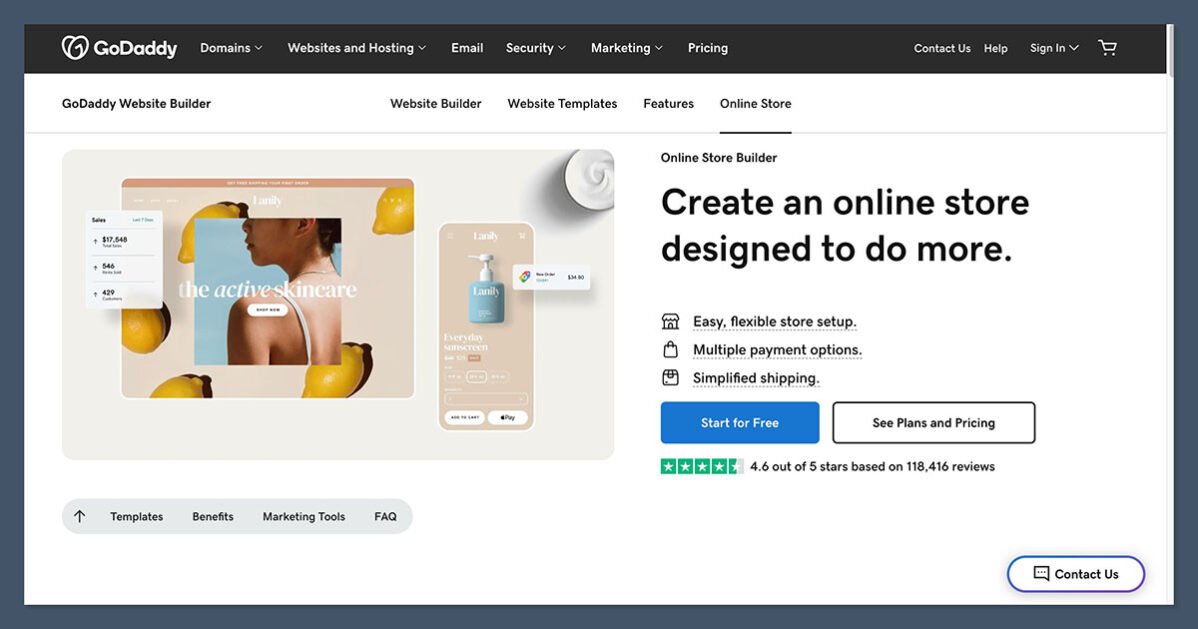
If raw cost is your deciding factor, GoDaddy comes out ahead. Its full online store sits inside the top-tier Commerce plan, which starts at $20.99 per month on annual billing. That is cheaper than Shopify’s entry point, and it bundles your domain, hosting, builder, and store into a single subscription.
Shopify’s pricing runs from $29 to $299 per month when billed annually across its three core plans. Here is how those tiers break down:
- Basic: $29/month annually ($39 billed monthly), 2.9% + 30¢ per online card transaction. A full store with unlimited products, abandoned cart recovery, and up to 2 staff accounts.
- Grow: $79/month annually ($105 billed monthly), 2.6% + 30¢ per transaction. Adds professional reports, more inventory tools, and up to 5 staff accounts.
- Advanced: $299/month annually ($399 billed monthly), 2.4% + 30¢ per transaction. Adds custom reporting, lower real-time shipping rates, and up to 15 staff accounts.
Shopify also runs an introductory deal that gets you the first 3 months for $1/month, plus a $5/month Starter plan for selling through social and chat without a full storefront. The catch is a short 3-day free trial, which is barely enough time to explore the platform.
GoDaddy gives you a more generous 7-day free trial, and neither builder asks for card details to start one. It is worth knowing that GoDaddy only unlocks a real online store on its Commerce plan, so the cheaper Basic and Premium tiers will not let you sell products properly.
GoDaddy also charges no sales commission of its own, though your payment processor still takes 2.7% + 30¢ per transaction through its PayPal partnership. Be aware that GoDaddy’s promotional prices rise at renewal, and add-ons like domain privacy or extended SSL can stack up.
The Winner: GoDaddy
GoDaddy’s Commerce plan undercuts Shopify’s cheapest tier and folds your domain and hosting into one bill, making it the more affordable way to launch a simple store.
Best for Selling Online: Shopify

This is where the gap really opens up. Shopify is built from the ground up for ecommerce, while GoDaddy’s store is a capable but lightweight add-on to a general website builder.
Sales Features
Shopify gives you unlimited products with variants, bundles, and metafields, alongside built-in abandoned cart recovery, discount codes, customer segmentation, and customer accounts.
When we tested it, the depth of inventory and order management stood out, especially for stores carrying a wide range of products. Shopify Magic, its built-in AI, can also generate product descriptions in seconds.
GoDaddy covers the basics well: you can list unlimited products, take payments, apply discounts, and sync stock. But the catalog is simpler, with fewer variant options and minimal marketing automation.
It leans more toward a static catalog plus checkout than a full selling engine, which is fine for a small range of products but limiting as you grow.
Payment Options
Shopify connects to more than 100 payment methods, including PayPal, Apple Pay, and Google Pay, and you can run several at once. Its native gateway, Shopify Payments, removes extra transaction fees and charges 2.9% + 30¢ on Basic, dropping to 2.4% + 30¢ on Advanced.
If you use a third-party processor instead, Shopify adds a small surcharge per order.
GoDaddy keeps payments simple, processing card transactions at 2.7% + 30¢ with no sales commission added on top. That flat, predictable rate is genuinely attractive for low-volume sellers, but you get less flexibility and fewer accelerated checkout options than Shopify’s Shop Pay can offer.
App Market
Shopify’s app store holds more than 8,000 third-party integrations covering loyalty, reviews, warehousing, analytics, and almost anything else. The trade-off is that many features live in apps rather than coming built in, so you spend time finding them and some carry their own monthly fees.
GoDaddy’s ecosystem is far smaller, and most extras arrive as GoDaddy-branded add-ons rather than an open marketplace. That keeps things tidy for beginners, but it caps how far you can extend your store once your needs get more specific.
The Winner: Shopify
Shopify’s sales features, 100+ payment options, and enormous app store give it a clear edge for anyone serious about selling and scaling.
Best for Marketing Products: Shopify
Listing products is only half the job. You also need to get them in front of customers, and Shopify offers far more firepower here.
Marketing Tools
Shopify connects directly to social platforms like Instagram and TikTok, and the Shopify Marketplace Connect app lets you sell across Amazon and Etsy from one dashboard. You can also build and send email campaigns with the built-in Shopify Email feature.
GoDaddy includes email marketing, automated abandoned cart messages, and social posting tools, and its multichannel sync reaches Amazon, eBay, Etsy, Walmart, and social feeds, but the campaigns are more basic and offer less segmentation.
SEO
Both platforms cover the SEO fundamentals, such as sitemaps, custom URLs, and image alt text. Shopify pulls ahead with stronger technical foundations and an SEO ecosystem of apps, including its Semrush-powered Ecommerce Booster, which surfaces actionable recommendations. GoDaddy offers a built-in SEO Wizard aimed at beginners, which is helpful for guidance but less powerful for stores chasing competitive rankings.
Internationalization
For stores selling across borders, Shopify is the stronger option. Shopify Markets supports multiple currencies, global payment methods, and translated storefronts that adapt to a visitor’s location. GoDaddy is built more for domestic or lightweight cross-border selling, so it is less suited to brands targeting global markets.
The Winner: Shopify
Shopify’s built-in marketing features, deeper SEO tooling, and proper international selling make it the better engine for promoting and growing a brand.
Easiest to Use: GoDaddy
Shopify and GoDaddy both aim to be beginner-friendly, but they approach it differently. GoDaddy is built around a no-code, AI-assisted builder that walks first-time users through setup with simple drag-and-drop editing. For someone with no ecommerce experience who wants a site live quickly, it is genuinely one of the easiest tools on the market.
Shopify’s onboarding is also smooth, asking a few questions about your business before guiding you into a clear dashboard with a setup checklist. Its section-based editor is straightforward, though it favors structured layouts over free-form design.
Where Shopify shines is the store backend: managing products, orders, and inventory feels purpose-built. Where GoDaddy shines is sheer simplicity for a basic site.
So the honest answer is that GoDaddy is easier for an absolute beginner building a simple site, while Shopify is easier specifically for running and managing a real store.
The Winner: GoDaddy
For pure beginner-friendliness and a fast, no-fuss launch, GoDaddy’s AI builder is the gentler starting point.
Best Online Store Templates: Shopify
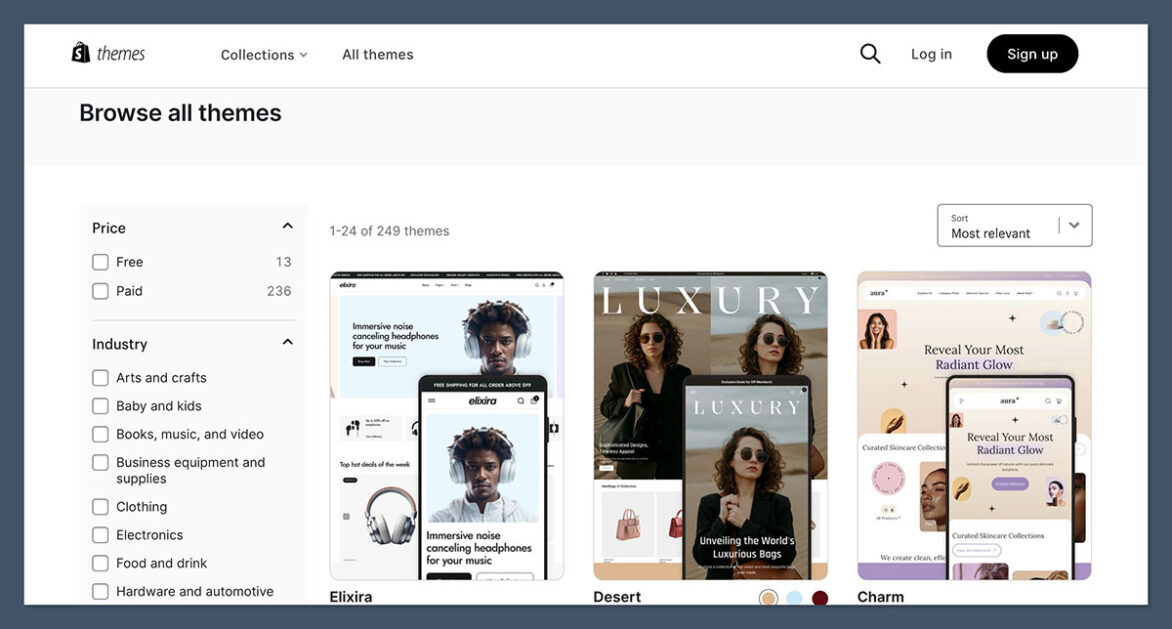
Your storefront needs to make a strong first impression, and Shopify’s design library is built specifically for selling. It offers more than 190 themes spanning a wide range of industries, with mobile-first layouts, high-conversion checkout patterns, and deep customization through its theme editor and code access.
GoDaddy’s templates are simpler and lean toward generic, service-oriented sites.
They work fine for a small store bolted onto an informational website, but they offer less visual control and fewer ecommerce-focused layouts than Shopify. Both platforms include a limited number of free themes, with Shopify offering 13 free options and premium themes typically running between $100 and $500 as a one-time purchase.
The Winner: Shopify
Shopify’s themes are more modern, more numerous, and built for conversion, giving sellers a stronger design foundation.
Best for Domains and Hosting: GoDaddy
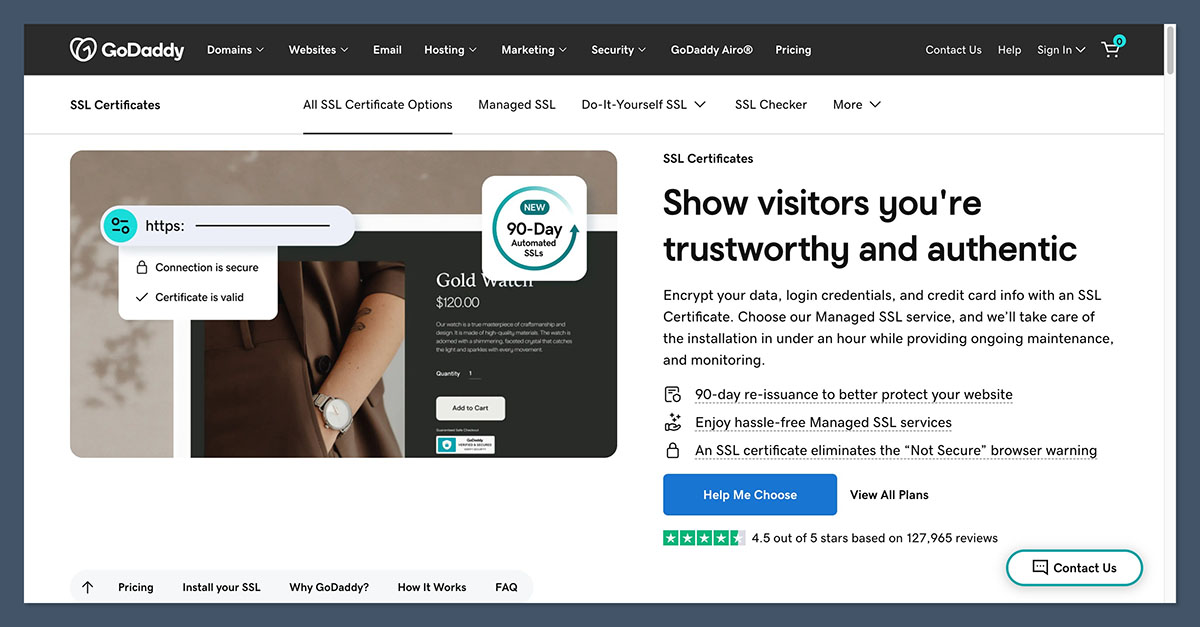
This is GoDaddy’s home turf. As one of the largest domain registrars in the world, it bundles your domain, hosting, email, and builder into a single account, which removes a lot of the setup friction beginners dread. Many store owners actually buy a domain on GoDaddy and connect it to a Shopify store, which works but requires manual DNS configuration.
Shopify includes hosting with every plan and sells domains with free SSL and WHOIS privacy, auto-configuring them for your store, which is convenient for beginners who want everything in one place. GoDaddy’s domain pricing is often very low in the first year but can rise sharply at renewal, and SSL or privacy protection may cost extra, so it pays to read the fine print.
The Winner: GoDaddy
For an all-in-one bundle of domain, hosting, and site builder under one roof, GoDaddy is the more convenient and cost-effective package.
Best for Support: GoDaddy
Both platforms offer 24/7 support, but they suit different kinds of users. Here is how they compare.
Shopify support
- 24/7 live chat in the Help Center, with escalation to a human advisor for complex issues
- An extensive Help Center packed with guides, video tutorials, courses, and a large community forum
- A huge ecosystem of agencies, developers, and creators for hands-on help
- Phone and priority support are reserved for higher tiers and Shopify Plus
- Email support has been phased out in favor of chat
GoDaddy support
- 24/7 phone support, which is rare among website builders and reassuring for beginners
- Live chat and a help center with guides and tutorials
- Consistently strong customer satisfaction scores for direct, human help
- Support is geared toward domains and simple sites rather than advanced ecommerce
- Some users report add-on heavy checkout flows that need careful reviewing
Shopify’s self-serve resources and ecosystem are deeper, which is invaluable once you are scaling. But for a new seller who simply wants to call someone and get an answer, GoDaddy’s always-on phone support gives it a narrow edge.
The Winner: GoDaddy
GoDaddy’s 24/7 phone support and beginner-focused service make it the more reassuring option for first-time store owners.
How We Test Ecommerce Website Builders
We review the leading ecommerce builders using a structured, repeatable research process so our recommendations reflect real, hands-on use rather than marketing claims. We carried out more than 200 hours of testing across seven weighted areas:
| Testing area | Weight | What we assess |
|---|---|---|
| Sales Features | 40% | The core ecommerce capabilities of the platform |
| Website Features | 15% | Quality and quantity of site features, such as SEO |
| Help and Support | 12% | Support channels and self-serve resources |
| Design Functionality | 10% | Templates and design options for stores |
| User Experience | 10% | Hands-on ease of use and accessibility |
| Customer Score | 8% | How the platform performs against competitors |
| Value for Money | 5% | Pricing plans and what you get for the cost |
We tested both Shopify and GoDaddy ourselves, building stores on each platform to make sure the insights here come from genuine first-hand experience with how each one looks, feels, and performs.
Shopify vs GoDaddy: Our Winner
For businesses whose main goal is to sell online and grow, Shopify is the stronger ecommerce platform. Its sales features, marketing tools, design library, and app ecosystem are built for stores that expect to scale and sell across channels and borders.
If ecommerce is the engine of your business, Shopify is the safer long-term bet.
GoDaddy, though, is far from an also-ran. It is cheaper to start, easier for complete beginners, and bundles your domain, hosting, and store into one tidy package backed by excellent 24/7 phone support. For a local shop, a service business, or anyone listing a small range of products alongside informational pages, GoDaddy can be the smarter, simpler choice.
The best approach is to match the platform to your ambition.
Choose Shopify if you are building a product-first business with room to grow, and choose GoDaddy if you want an affordable, all-in-one site where the store is one part of the picture. Both offer free trials, so it is worth testing each before you commit.
Frequently Asked Questions
Is Shopify better than GoDaddy for ecommerce?
Yes, for dedicated ecommerce Shopify is the stronger platform. It offers deeper sales features, more payment options, a much larger app store, and better tools for marketing and international selling. GoDaddy can run a perfectly good simple store, but it is built more as a general website builder than a full ecommerce engine.
Is GoDaddy cheaper than Shopify?
For a basic store, yes. GoDaddy’s Commerce plan starts at $20.99 per month on annual billing and bundles in your domain and hosting, while Shopify’s cheapest full-store plan is $29 per month. Keep in mind that GoDaddy’s promotional prices rise at renewal, and Shopify offers a $1/month introductory deal for the first three months.
Can I use a GoDaddy domain with a Shopify store?
Yes. Many sellers buy a domain through GoDaddy and connect it to a Shopify store. The process is straightforward but requires manually updating your DNS settings to point the domain at Shopify.
Does GoDaddy charge transaction fees?
GoDaddy does not add a sales commission of its own, but your payment processor charges around 2.7% + 30¢ per transaction through its PayPal partnership. Shopify charges 2.9% + 30¢ on its Basic plan when using Shopify Payments, with rates dropping on higher tiers.
Which is easier for beginners, Shopify or GoDaddy?
GoDaddy is generally easier for absolute beginners building a simple site, thanks to its AI-assisted, drag-and-drop builder and 24/7 phone support. Shopify is easy to use too, and it is more intuitive specifically for managing products, orders, and inventory in a growing store.
Which platform should I choose?
Choose Shopify if selling is the core of your business and you expect to grow, scale, or sell internationally. Choose GoDaddy if you want an affordable, all-in-one bundle for a simple store or a service site where ecommerce is a secondary feature. Both offer free trials so you can test the fit first.