Selling inside one Latin American country? Tiendanube. A forever-free plan, billing in your own currency and a native payment gateway are things Shopify does not offer at any price.
Crossing borders, selling wholesale, or need something niche? Shopify. Markets, native B2B and roughly 18,000 apps are what a one-store-per-country architecture cannot answer.
Selling in Mexico? It is genuinely close, and the reason is one date: Shopify Payments went live there on March 3, 2025.
Here is the problem with every shopify vs tiendanube comparison currently ranking for that search: almost all of them are written by someone with a stake in your answer.
Of the three most substantive results, one is published by Tiendanube about Tiendanube. The other two belong to agencies that sell one of the two platforms for a living. They are not useless. They are not disinterested either. And if you sell in Argentina, Mexico, Colombia, Chile or Brazil and you read in English, you have been choosing between a USD subscription and a peso-priced one on the strength of numbers nobody bothered to date.
So this comparison was built to a different standard:
How this comparison was put together
- Live pricing, not recycled pricing. Plan prices come from both vendors’ own pricing pages, checked on July 30, 2026. The most-cited Spanish-language comparison still quotes Shopify Basic at $19 USD. That plan does not exist.
- Every figure keeps its own currency. No invented peso conversions, and where a source performed one, it is labelled as theirs.
- Disagreements are shown, not smoothed over. Sources conflict on things as basic as what Tiendanube’s Mexican plans are called, so both versions appear side by side with their dates attached.
- No test store, and no pretending otherwise. You will not find a single claim here about how either dashboard felt to use, because nobody logged into one to write this.
What that turns up is that the best ecommerce platform for Latin America is a per-country question, not a per-platform one. The table below is where that starts to show.
| Dimension | Shopify | Tiendanube (Nuvemshop in Brazil) |
|---|---|---|
| Best for | Selling across borders, deep customisation, apps | Selling inside one LatAm country, fast launch, local payments |
| Markets | Global, roughly 27.6% of tracked ecommerce platforms worldwide | Argentina, Mexico, Colombia, Chile, Brazil (as Nuvemshop) |
| Entry price | $39 USD/mo Basic ($29 effective billed annually), no free plan | Free Inicial/Começo plan forever; paid from R$69 BRL, $24,900 COP, $5,999 CLP or $26,999 ARS per month |
| Billing currency | USD | Local currency in every market |
| Native payment gateway | Shopify Payments, live in Mexico since March 3, 2025, not available in Argentina, Colombia or Chile | Pago Nube / Nuvem Pago, native in every market it operates |
| Fee for using another gateway | 2% Basic, 1% Grow, 0.6% Advanced, 0.2% Plus | 2% free plan, 1% Esencial, 0.7% Impulso, negotiable above (Argentina ladder) |
| Apps | ~17,600 to 18,400 per 2026 third-party trackers | 700+ per Tiendanube’s own app store page; third-party estimates run 130 to 200 |
| Themes | ~268 to 287 in the official Theme Store, 23 to 24 free | 65+ templates on paid plans (vendor claim); 1 layout with 4 variants on free |
| Multi-currency | Shopify Markets, 20+ languages | One store per country, no native multi-market |
| Native B2B | Yes, on every paid plan since April 2, 2026 | Custom price tables only |
| Support | 24/7 chat and help centre; phone and email reported as Plus-only | Native Spanish and Portuguese, channels widen by plan (WhatsApp on Impulso, video call on Escala) |
Two rows in that table do most of the work: the billing currency, and the one about Shopify Payments.
What You Are Actually Choosing Between
On raw global share this is not a close comparison. Shopify holds roughly 27.6% of tracked ecommerce platforms worldwide across more than 6.9 million stores, while Tiendanube’s global share sits near 0.16%. That is also the wrong lens, because Tiendanube has never competed for global share. It competes for one region, and inside that region the shape of the contest changes completely.
Shopify is a global SaaS platform with four self-serve tiers plus an enterprise tier, sold everywhere, priced in USD, and run as a worldwide product where Latin America is one region among many. Shopify Payments arrived in Mexico on March 3, 2025 and is still absent from Argentina, Colombia and Chile. That single asymmetry is the most consequential fact in this comparison, and the payments section below is largely about its consequences.
Tiendanube was founded in Argentina and operates in Argentina, Mexico, Colombia and Chile, plus Brazil under the Nuvemshop brand. Its scale figures are vendor-stated rather than audited: 180,000+ active brands, roughly $2 billion in annual GMV, more than 1,000 staff, and a claimed 9% of all Argentine ecommerce. Independently reported: a $500 million Series E in 2021 led by Insight Partners and Tiger Global at a reported $3.1 billion valuation, which made it a Latin American unicorn.
One nuance nobody covers
BuiltWith’s Brazil dataset detects more Shopify sites (97,826, a 12.89% share) than Nuvemshop sites (63,983, 8.43%). A different tracker, ShopRank, counts 115,435 active Nuvemshop stores overall with 64,813 of them in Brazil. Detection methods differ and produce different totals, so treat both as directional. What neither dataset supports is the idea that Nuvemshop owns Brazil as a measured fact rather than a positioning line.
Which brings up the sources problem. The three substantive Tiendanube vs Shopify comparisons ranking for this search are Tiendanube’s own blog, Atempora (a Mexico-based Shopify agency that discloses its bias on the page), and Nubea (an app vendor and Tiendanube partner). Each is useful and none is disinterested. That is why every number below carries a date and a source.
1. Pricing, Plans, and the Currency You Pay In
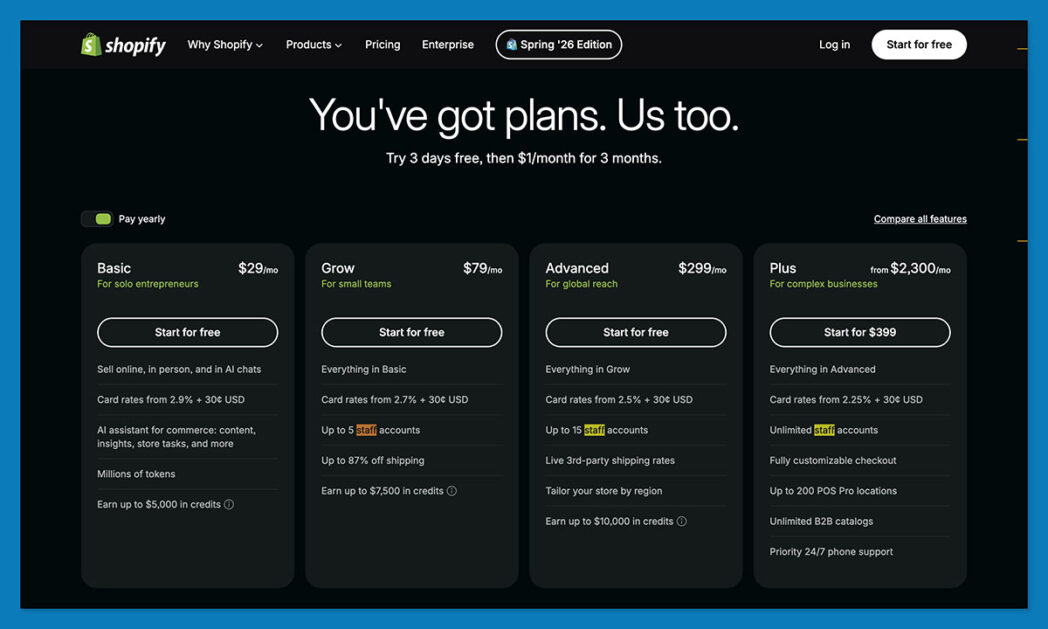
The Shopify Basic price quoted in the most-cited Spanish-language comparison is $19 USD, and it does not exist in 2026. Basic is $39 USD per month billed monthly, or $29 effective when billed annually under Shopify’s 25% annual discount. Doubling one side of an entry-price comparison changes the answer, so start from dated figures.
| Market | Tiendanube plans (monthly, local currency) | Shopify plans (monthly, USD) |
|---|---|---|
| Argentina (live-fetched 2026-07-30) | Inicial free; Esencial $26,999 ARS; Impulso $78,999 ARS; Escala $234,999 ARS; Evolución custom. Annual billing cuts 25% ($20,249.25 / $59,249.25 / $176,249.25) | Basic $39; Grow $105; Advanced $399; Plus custom from roughly $2,300+. Annual billing cuts 25% (Basic $29) |
| Mexico (UNRESOLVED across three sources) | Set A: Essential $149 / Impulse $374 / Scale $999 MXN. Set B: Básico $99 / Tiendanube $249 MXN (Atempora). Set C: Gratuito $0 / Inicial ~$499 / Profesional ~$999 / Plus ~$2,399 MXN (negocioderopa, 2025-dated) | Same USD ladder |
| Colombia | Básico $24,900 COP; Tiendanube $49,900 COP; Avanzado $149,900 COP. 25% annual discount | Same USD ladder |
| Chile | Básico $5,999 CLP; Tiendanube $14,999 CLP; Avanzado $44,999 CLP. VAT treatment not stated in the source | Same USD ladder |
| Brazil (Nuvemshop) (live-fetched 2026-07-30) | Começo free; Essencial R$69; Impulso R$164; Escala R$449; Next custom above R$100k/month revenue. 15% annual discount, single-instalment credit card only | Same USD ladder |
Three sources give three different plan-name sets for Tiendanube pricing in Mexico, and no live MX pricing page was fetched during this research. Set A mirrors the confirmed Argentine structure of three paid tiers plus a free plan plus a custom tier, which makes it the most plausible, but plausible is not confirmed. Check tiendanube.com/mx/planes-y-precios yourself before you budget, because this is the one figure in this article that could not be resolved.
Free plan versus no free plan. Tiendanube’s Inicial plan, called Começo in Brazil, is free forever with unlimited products, sales and visits, and paid tiers carry a 7-day trial. Shopify has no equivalent. Its $5 Starter tier is a social-selling and link-in-bio product rather than a storefront, so the real entry point is a 3-day trial, then $1 a month for three months, then $39.
Currency is itself a cost. Tiendanube prices in ARS, MXN, COP, CLP and BRL, so your subscription is a fixed local number you can put in a budget. Shopify prices in USD, so the identical plan costs a different amount of pesos every month depending on the exchange rate. No native LatAm price list for Shopify was found in this research, and the MXN figures circulating in agency posts are conversions somebody performed, not prices Shopify publishes.
Annual discounts are not equivalent. Shopify takes 25% off for annual billing. Tiendanube takes 25% off in Argentina and Colombia. Nuvemshop takes 15% off in Brazil, and only if you pay by credit card in a single instalment. Any Tiendanube pricing comparison has to run monthly rate against monthly rate, or the discount does the arguing for you.
Verdict on this section:
On cost of entry and currency exposure, Tiendanube wins outright, and its free plan has no Shopify equivalent at any price. That subscription is also the smallest of the four numbers you will actually pay, which is what the next section is about.
2. Payment Processing and What a Sale Actually Costs
Tiendanube markets zero commissions. Shopify’s Basic plan costs $39 a month. Both are true, and neither tells you what a sale costs, because a sale is priced in four separate layers:
- The subscription. What you pay to have a storefront at all.
- The platform’s cut. What it charges you for using a payment gateway it does not own.
- The gateway’s commission. What the processor charges to move the money.
- Tax on the fee. 16% IVA in Mexico, VAT in Argentina and Chile, applied to the commission itself.
Most comparisons stop at layer one.
The zero-commission claim, handled fairly. Tiendanube genuinely does not skim each sale when you use Pago Nube, a real structural difference from Shopify’s surcharge model. Pago Nube’s own processing and release commission still applies: in Argentina, from 3.50% plus VAT on the free plan, 3.49% on Esencial, 3.29% on Impulso and 2.99% on Escala, depending on how fast you withdraw. Tiendanube’s own help centre documents Mexico’s free plan at 3.99% + $3 MXN + VAT for a 7-day withdrawal or 3.49% + $3 MXN + VAT for a 2-day one, and that plan cannot use any gateway except Pago Nube. Zero commission describes the platform’s cut, not the cost of accepting a card.
The availability asymmetry. Shopify Payments went live in Mexico on March 3, 2025 per Shopify’s own changelog, and Shopify’s supported-countries documentation confirms it is not available in Argentina, Colombia or Chile. Research did not confirm Brazil in either direction, so nothing here asserts it. The consequence is blunt: in Argentina, Colombia and Chile every Shopify merchant is on a third-party gateway by force, paying Shopify’s surcharge on top of the gateway’s own commission. In Mexico they can avoid it.
One agency source reports Basic 3.6%, mid-tier 3.4% and Advanced 3.2%, all plus $3 MXN. A separate cluster of 2026 agency sources reports Basic 3.5%, Grow 3.2%, Advanced 2.7% and Plus negotiated at 2.15% to 2.4%, also plus $3 MXN. Both agree 16% IVA lands on top of the commission. Treat it as a 2.7% to 3.6% range, not a number.
| Cost layer | Shopify (Mexico) | Shopify (Argentina) | Tiendanube (Mexico) | Tiendanube (Argentina) |
|---|---|---|---|---|
| 1. Subscription | $39 to $399 USD/mo | $39 to $399 USD/mo | Unresolved: $99 to $999 MXN/mo across three sources | $26,999 to $234,999 ARS/mo |
| 2. Platform cut on an outside gateway | 0% with Shopify Payments; 2% Basic / 1% Grow / 0.6% Advanced / 0.2% Plus without it | Unavoidable: 2% Basic / 1% Grow / 0.6% Advanced / 0.2% Plus (Shopify Payments not available) | 0% with Pago Nube; the free plan cannot use another gateway at all, and no MX surcharge ladder was confirmed in research | 0% with Pago Nube; 2% Inicial / 1% Esencial / 0.7% Impulso / negotiable above |
| 3. Gateway processing commission | Shopify Payments reported at 2.7% to 3.6% + $3 MXN by plan, two conflicting source sets | Third-party only, e.g. Mercado Pago at roughly 3% to 5% | Pago Nube 3.99% + $3 MXN at 7-day withdrawal, 3.49% + $3 MXN at 2-day (free plan) | Pago Nube from 3.50% Inicial, 3.49% Esencial, 3.29% Impulso, 2.99% Escala |
| 4. Tax on the fee | 16% IVA on the commission | VAT on the commission | 16% IVA on the commission | VAT on the commission |
The example below borrows its volume assumption from a Mexico-focused source and reports a range, not a total, because the underlying plan prices are in dispute.
| Mexico worked example | Tiendanube (free plan) | Shopify (Basic) |
|---|---|---|
| Assumption: orders per month | 15 | 15 |
| Assumption: average order value | $500 MXN | $500 MXN |
| Assumption: monthly revenue | $7,500 MXN | $7,500 MXN |
| Subscription | $0 | $39 USD, converted by the source to roughly $780 to $800 MXN |
| Platform cut on the gateway | $0 with Pago Nube | $0 with Shopify Payments, or 2% with an external gateway |
| Gateway commission plus tax | 3.99% + $3 MXN per order, plus 16% IVA | 2.7% to 3.6% + $3 MXN per order, plus 16% IVA |
| App spend assumed by the source | $10 to $50 USD equivalent | $500 to $800 MXN |
| All-in monthly total (directional) | roughly $845 MXN | roughly $1,445 to $1,950 MXN |
Two caveats. The Shopify column includes a USD-to-MXN conversion the source performed and this article did not verify. The Tiendanube column assumes the free plan, so a paid tier adds its subscription on top.
Argentina gets prose instead of a second table: no dated exchange rate was captured in research, and converting a peso total without one would be invention. Compare structures instead. A Tiendanube merchant on Esencial pays $26,999 ARS plus Pago Nube from 3.49% plus VAT. A Shopify merchant pays $39 USD, plus Mercado Pago’s roughly 3% to 5% plus VAT, plus the 2% Basic surcharge no Argentine merchant can avoid.
Verdict on this section:
On what a sale actually costs, Tiendanube takes Argentina, Colombia and Chile on structure rather than on rates. Mexico is close enough that your plan tier and the rate you are actually quoted decide it.
3. Shipping and Local Logistics
The cheapest platform stops being cheap the week you spend three evenings wiring up a courier integration. Shipping is where a regional platform earns its subscription, and where the public evidence is thinner than either vendor would like.
Tiendanube ships Envío Nube as a default. It is bundled into the plan structure across markets and marketed as included on all paid plans at no extra cost, with shipping-cost calculation available on every plan including the free one. That framing is a vendor claim, because research could not independently verify carrier coverage, published rates or per-country depth. Even Tiendanube’s own materials are thin on which carriers are supported where.
Shopify treats shipping as a plan feature plus an app problem. Live third-party carrier-calculated rates sit on the Advanced and Plus tiers, so a merchant on Basic or Grow either runs flat and manual rates or reaches for an app. Tiendanube’s comparison page frames this as limited to certain plans or available at extra cost, a vendor claim that is directionally consistent with how Shopify gates the feature.
The trade-off compresses to one line. Tiendanube gives you a working local default with less choice, while Shopify gives you the deepest fulfilment catalogue in ecommerce and expects you to assemble it, each app carrying its own recurring fee.
One thing this article will not do is name carriers. Competitor articles publish per-country courier lists, but research did not capture which carriers those lists contain. Check the list for your own country on each platform’s site, for the service level you actually need.
Verdict on this section:
If shipping has to work in week one in a single country, Tiendanube’s defaults are the shorter path. If your fulfilment is unusual, Shopify’s catalogue is the only one deep enough to contain the thing you need.
4. Apps, Themes, and How Far Each Ecosystem Stretches
The Shopify app numbers in every existing comparison are out of date, and the theme number Shopify markets about itself is roughly four times the size of its own store’s catalogue. Both distortions push in the same direction, so both are worth fixing before you weigh the ecosystem at all.
| What | Shopify | Tiendanube | Who counts it |
|---|---|---|---|
| Apps (2026) | ~17,600 to 18,400: one tracker counted 18,368 on May 4, 2026, another 17,891 active from 11,352 developer partners, a third 17,600+ in April 2026 growing about 550 a month | 700+ | Third-party trackers vs Tiendanube’s own live app store page, fetched 2026-07-30 |
| Counts still in circulation | 7,000 / 13,000 / 16,000 | 130 to 200 | Older snapshots (the ecosystem grew about 71% from early 2024 to Q1 2026) vs third-party agency estimates |
| Themes and templates | ~268 to 287 in the official Theme Store | 65+ on paid plans | Theme Store catalogue counts vs a Tiendanube vendor claim |
| Free themes | 23 to 24 | 1 layout with 4 style variants on the free plan | Both vendor-documented |
| Premium theme cost | roughly $180 to $400 USD (about $3,500 to $7,000 MXN) | about $1,500 to $4,500 MXN | A single Mexico-focused source, directional only |
| Code access | Liquid on every plan | HTML, CSS and JS from the mid-tier plan up | Vendor documentation |
Retire the stale figures. 7,000, 13,000 and 16,000 were each probably accurate the day they were written. The ecosystem grew roughly 71% between early 2024 and the first quarter of 2026, so the current number is materially higher than any of them. Shopify’s own marketing line of 1,000+ themes appears to count external marketplaces such as ThemeForest rather than the Theme Store it actually operates.
Tiendanube’s own count is unresolved. Its live app store page says 700+, while two third-party sources say 130 to 200. The likeliest explanation is a counting-methodology or per-country-visibility difference, and nobody has confirmed which, so the table carries both.
One cherry-pick worth naming. Tiendanube’s comparison page credits Shopify with 13 design templates against its own 65+. Against a Theme Store holding roughly 270 to 290, that framing does not survive contact with the catalogue.
Most stores run five to ten apps. A 25-to-1 catalogue advantage only converts into value when your need is niche, and the places it bites are predictable: subscriptions and recurring billing, advanced B2B, complex dropshipping, ERP and accounting integrations, and narrow vertical requirements. Tiendanube’s catalogue has the opposite kind of depth, stocking LatAm-specific tools a global store does not carry, including card-instalment apps and local ERP connectors.
Built-in tooling, briefly. Shopify Email includes 10,000 free emails a month counted per unique recipient, then $1 per additional 1,000 up to 300,000, with abandoned-checkout emails always free. Tiendanube answers with Marketing Nube, a rebrand of the acquired Perfit email tool rather than a from-scratch build, and Chat Nube, an AI chatbot for WhatsApp and the storefront whose capability claims are vendor marketing.
Verdict on this section:
Shopify wins this criterion on any count anyone offers. The win only turns into money if you need something specific enough that 700 apps do not already cover it.
5. Growing Past One Country
The platform decision that looks cheapest today is the one most likely to be re-made in eighteen months, and the trigger is almost always the same: a second country, a wholesale customer, or a shop counter.
- Multi-currency and multi-market. Shopify Markets runs multi-currency storefronts across 20+ languages. The claim that Markets multi-currency is gated behind having Shopify Payments active comes from Tiendanube’s own comparison content and was not independently confirmed against Shopify’s Markets documentation here. If true it matters enormously, because Shopify Payments does not exist in Argentina, Colombia or Chile. Tiendanube has no native multi-currency capability at all, architected as one store per country and described as “no nativo” by an agency source with no Tiendanube affiliation.
- B2B and wholesale. Shopify launched native B2B in 2023, and since April 2, 2026 the foundational set sits on every paid plan rather than Plus alone (company accounts, up to three custom pricing catalogues, volume discounts and quantity rules, payment terms, vaulted cards). Tiendanube offers custom price tables instead: three on Esencial, unlimited on Impulso. No purpose-built B2B module appears in its own plan feature lists, which is an absence in the documentation rather than a confirmed missing feature.
- In-person selling. Shopify POS Lite is bundled free with every paid plan, and POS Pro costs $89 per month per location, or $79 billed annually. Tiendanube’s PDV Nube launched in Mexico in 2025, runs in the browser with nothing to install, works with barcode scanners, card terminals and printers you already own, and logs sales that started on WhatsApp or social alongside in-person ones. The first location is free; additional branches cost extra at an unpublished price.
- The top tier. Shopify Plus is custom-quoted and reported from roughly $2,300 a month. Tiendanube Evolución is also custom-quoted with no public price, and includes a dedicated ecommerce specialist, assisted migration and priority support on every channel.
Verdict on this section:
If selling outside your own country is anywhere on the plan, this section is the entire argument for paying Shopify’s premium. If it is not, you are paying every month for a ceiling you will never reach.
6. Brazil, Where Tiendanube Is Nuvemshop
Brazil is Tiendanube’s largest market and the one every comparison skips, including the vendor’s own. The product a Brazilian merchant actually buys is branded Nuvemshop, priced in reais on the ladder above, and shaped by a payment method that exists nowhere else in this region.
Pix changes the arithmetic. Nuvem Pago charges a flat 0.99% on Pix receipts, the same rate on every Nuvemshop plan, with no activation fee, no monthly fee for Nuvem Pago itself, and free balance transfers to a Bradesco account. Set that against card commissions of roughly 3% to 4% plus tax everywhere else in the region and it is the single biggest structural cost lever in this article. Nuvemshop’s own content positions Pix alongside cards and boleto bancário as a 2026 default, so the framing is vendor-sourced even though the rate is documented.
The outside-gateway ladder works the same way here. Começo 2%, Essencial 2%, Impulso 1%, Escala 0.7%, Next custom. A Brazilian merchant who brings their own processor pays twice, exactly as an Argentine one does.
Research confirmed availability in Mexico and absence in Argentina, Colombia and Chile. Brazil was not confirmed either way, so this article does not assert it. Check Shopify’s supported-countries page for Brazil before you budget. If it is unavailable, the third-party surcharge lands on every sale exactly as it does in Argentina.
The dominance myth, gently. BuiltWith detects 97,826 Shopify sites in Brazil at a 12.89% share against 63,983 Nuvemshop sites at 8.43%. ShopRank puts Nuvemshop’s Brazil footprint at 64,813 verified stores, 57.9% of its verified base. Methodologies differ and both are directional, but no independent tracker found here supports the claim that Nuvemshop dominates its home turf.
Verdict on this section:
For a Brazilian store where Pix carries the sales mix, the Nuvemshop vs Shopify decision is settled by the fee gap alone. For one selling mostly on cards to buyers outside Brazil, that advantage evaporates.
7. Support, Language, and What Merchants Actually Say
Support quality is invisible until a payout is frozen. Then it is the only feature that matters.
Tiendanube’s structural advantage is real. Support arrives in native Spanish and Portuguese, not translated English, and channels widen as you climb: basic on Inicial, email and messenger on Esencial, WhatsApp on Impulso, video calls on Escala, a dedicated specialist on Evolución. That ladder is also a fair criticism: the cheapest plans get the least access at the stage when a merchant knows least.
Shopify runs 24/7 chat and a large help centre available in Spanish, though one independent review notes phone and email are Plus-only. Tiendanube’s comparison also claims Shopify support redirects merchants to English documentation, a vendor claim.
Merchant sentiment needs its caveats attached:
- Spanish-language Trustpilot rates Tiendanube 2 out of 5 and Shopify 1.3 out of 5. Both are dominated by shoppers complaining about scams and non-delivery by individual sellers on each platform, not by merchants rating software. Read them as a lesson in how review sites get contaminated, never as a platform-quality signal.
- Reclame Aqui, Brazil’s public complaints registry, rates Nuvemshop 7.9 out of 10 over the trailing six months, Good and RA1000-certified, with 72.5% saying they would do business again, an 84.3% resolution rate and a 9 day 18 hour average response time. Vivid threads about blocked funds sit alongside it.
- Recurring merchant themes. On Tiendanube: slow withdrawals and repeated documentation requests during payout disputes, per a complaint aggregator that skews negative by design, plus a public Nuvemshop outage complaint on X. On Shopify: a cost stack reaching roughly $50 to $150 USD a month in Latin America once gateway fees, apps and currency conversion land on top.
- One trap. The named merchant testimonials in one agency pricing post trace back to no interview or review platform, so the pattern appears here and the names do not.
- Scoped correctly. Google Play rates Tiendanube’s app 4.5 and Shopify’s 4.3, measuring the mobile management apps, not the platforms.
Verdict on this section
If support in your own language on a cheap plan is decisive, Tiendanube is built for that and Shopify is not. Neither platform’s public record is clean.
8. Speed, and the Performance Claim Nobody Can Check
The most-repeated performance claim in this comparison traces back to exactly one source, and that source sells one of the two platforms.
The claim. Tiendanube’s own blog states that a 2026 Google Chrome UX Report shows stores built on Tiendanube are faster and more stable than Shopify stores across Latin America. Affiliate and agency blogs, Nubea among them, repeat it in near-identical wording.
What is missing. No methodology, no dataset link, no named analyst, and no independent HTTP Archive or CrUX analysis that mentions Tiendanube at all. The sources repeating the claim appear to be citing Tiendanube’s press materials rather than the underlying data.
Why that matters more than usual. The CrUX dataset is public and queryable through BigQuery. Anyone holding the claim and an afternoon could check it. It has simply never been checked in public.
The independent data that does exist, scoped correctly. An analysis of roughly 200,000 Shopify sites published by fudge.ai in 2026 found 93% pass Google’s fast threshold, 52% pass all three Core Web Vitals, a median mobile LCP of 2.26 seconds, and 48% passing every mobile CWV threshold. That study is Shopify-only. It does not benchmark Tiendanube, so it can neither confirm nor refute the claim.
What actually decides your store’s speed. On both platforms, real-world performance is dominated by theme weight, image handling and how many apps inject scripts into your pages. Those are your choices, on either platform.
Verdict on this section:
Unproven, not disproven. Until someone publishes the query, treat it as marketing.
The Bottom Line: Which One Fits Your Situation
There is no single best ecommerce platform in Latin America. The answer depends on which country you sell in and whether you intend to leave it.
- Selling in one LatAm country on a tight budget, or still validating: Tiendanube. A forever-free plan, local-currency billing and a native gateway have no Shopify equivalent.
- Selling in Argentina, Colombia or Chile: Tiendanube, on structure rather than price. Shopify Payments does not exist there, so every Shopify sale carries the third-party surcharge on top of the gateway’s commission.
- Selling in Mexico: genuinely close. Shopify Payments has been live since March 2025, removing the surcharge and narrowing the gap to a rate difference. Decide on ecosystem needs, tolerance for USD billing, and check the current Tiendanube MX prices yourself.
- Brazil, with Pix carrying the sales mix: Nuvemshop. A flat 0.99% against 3% to 4% plus tax on cards is the largest single cost lever here. Do not assume dominance though: trackers detect more Shopify sites in Brazil.
- Crossing borders, adding wholesale, or opening a physical location: Shopify. Markets, native B2B on every paid plan since April 2026, POS Pro and roughly 18,000 apps are what a one-store-per-country architecture cannot answer.
- Needing something niche, whether subscriptions, ERP, advanced B2B or heavy customisation: Shopify. That is exactly where a 700-app catalogue runs out.
Before you sign
Run the four-layer math at your own average order value and ask each vendor for its fee schedule in writing. Know the migration asymmetry too: Tiendanube publishes an official Import Shopify app, while the reverse is a manual CSV export plus a theme rebuild. Some merchants run both.
Shopify vs Tiendanube: Frequently Asked Questions
Does Tiendanube really charge zero commission?
Tiendanube takes no cut of the sale itself, which is a genuine difference from Shopify’s surcharge model. Pago Nube’s own processing and release commission still applies: roughly 2.99% to 3.99% plus VAT depending on plan and withdrawal speed, plus $3 MXN per transaction in Mexico. Zero commission describes the platform’s cut, not the cost of accepting a card.
Is Shopify Payments available in Latin America?
Yes in Mexico, live since March 3, 2025, with payouts in MXN. No in Argentina, Colombia and Chile, where merchants must use third-party gateways and pay Shopify’s extra surcharge of 2% on Basic down to 0.2% on Plus. Brazil was not confirmed either way in our sources, so check Shopify’s supported-countries page.
Which is cheaper for a small store in Argentina, Shopify or Tiendanube?
Structurally, Tiendanube. Because Shopify Payments does not exist in Argentina, an Argentine Shopify merchant pays Mercado Pago’s roughly 3% to 5% plus VAT and Shopify’s 2% Basic surcharge on the same sale, on top of a USD subscription that moves with the exchange rate every month.
How many apps and themes does each platform actually have?
Shopify has roughly 17,600 to 18,400 apps in 2026 and about 268 to 287 official Theme Store themes, not the older 7,000 to 16,000 app figures or the marketed 1,000+ themes. Tiendanube lists 700+ apps on its own store page, though third-party estimates say 130 to 200, plus 65+ templates on paid plans.
Does Nuvemshop dominate Brazil?
Not according to the independent trackers found here. On a Nuvemshop vs Shopify head count, BuiltWith detects more Shopify sites in Brazil (97,826, a 12.89% share) than Nuvemshop sites (63,983, 8.43%), while ShopRank counts 64,813 verified Nuvemshop stores there. Treat dominance framing as positioning rather than measurement, and note that trackers disagree on absolute totals.
Can I switch from Shopify to Tiendanube later?
Both directions work, but they are not symmetric. Tiendanube publishes an official Import Shopify app that moves products, variants, collections and customers automatically. Going the other way means a manual CSV export and import. Themes are not portable in either direction, so you rebuild the storefront design regardless of which way you move.