When comparing ecommerce shipping platforms, Pirate Ship and Shippo are often the two names that rise to the top, but which one actually delivers the most value for your store?
After analyzing their features, pricing, support, and real-world use cases, Pirate Ship is the ideal choice if you’re looking for a simple, free platform to handle domestic USPS and UPS shipping. On the other hand, Shippo is the better pick if your business needs international carrier support, branded tracking, automation, and API flexibility.
Let’s break down which is the best fit for your business.
Pirate Ship vs Shippo: Quick Verdict
Pirate Ship – Best for small stores focused on simple, low-cost USPS or UPS shipping (100% free)
Shippo – Best for growing stores needing carrier variety, automation, and international support
In this review, we’ll compare Pirate Ship and Shippo across the areas that matter most to your business, pricing, carriers, automation, branding, integrations, and more, so you can make the right call based on your needs.
💡 Key Takeaways
- Pirate Ship is completely free and ideal for small ecommerce stores shipping within the U.S.
- Shippo supports 40+ carriers, offers automation, returns, and branded tracking, but charges fees after a threshold.
- Pirate Ship is simpler and faster to use but lacks international carriers and API access.
- Shippo is better for scaling businesses that need more complex shipping workflows and multi-carrier options.
A Quick Comparison of Pirate Ship vs Shippo
Here’s a side-by-side look at how both platforms compare on the core features:
| Feature | Pirate Ship | Shippo |
|---|---|---|
| Cost | Free (no monthly fee or label fees) | Free plan + paid tiers ($10+/mo) |
| USPS Commercial Pricing | ✅ Yes | ✅ Yes |
| UPS Discounts | ✅ Yes | ✅ Yes |
| FedEx / DHL Express | ❌ No | ✅ Yes |
| International Shipping | Limited (Simple Export Rate only) | Full international carrier support |
| Returns | Pay-on-use return labels | Built-in return flow |
| Custom Tracking Pages | HTML emails only | Branded tracking (paid plans) |
| API Access | ❌ No | ✅ Yes |
| Best For | Small U.S.-based shops | Growing ecommerce operations |
What Kind of Business Is Pirate Ship or Shippo Best For?
Let’s take a closer look at which type of ecommerce store is most likely to benefit from Pirate Ship or Shippo.
Pirate Ship Is Best For…
- New or small ecommerce shops focused on U.S.-only shipping
- Businesses that prioritize zero monthly software costs
- Stores with lightweight international shipments under 4 lbs (Simple Export Rate)
- Entrepreneurs looking for a basic, fast label printing solution with no extra frills
Shippo Is Best For…
- Scaling brands that need multi-carrier rate comparisons
- Businesses with international customers or warehouses outside the U.S.
- Stores requiring branded tracking pages, shipping automation, or custom packaging rules
- Developers looking for an API to integrate directly into a logistics workflow
1. Best for Pricing: Pirate Ship
🏆 Winner: Pirate Ship
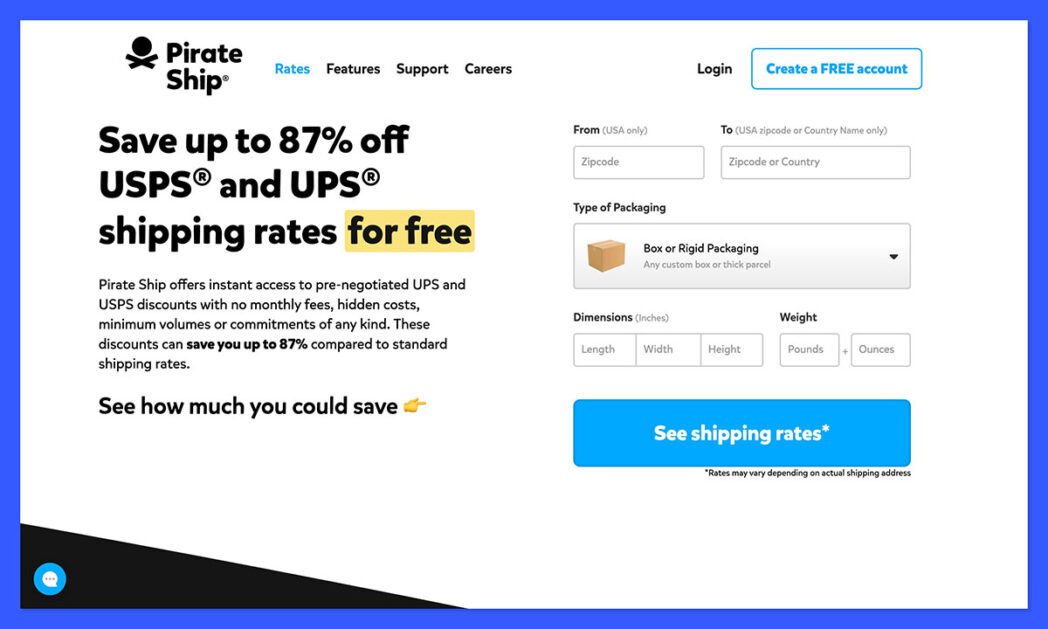
Pirate Ship’s pricing is refreshingly simple, it’s 100% free to use. You don’t pay for access to the platform, there are no monthly fees, and there are no per-label charges. You simply pay the postage cost at discounted USPS and UPS Commercial Pricing rates.
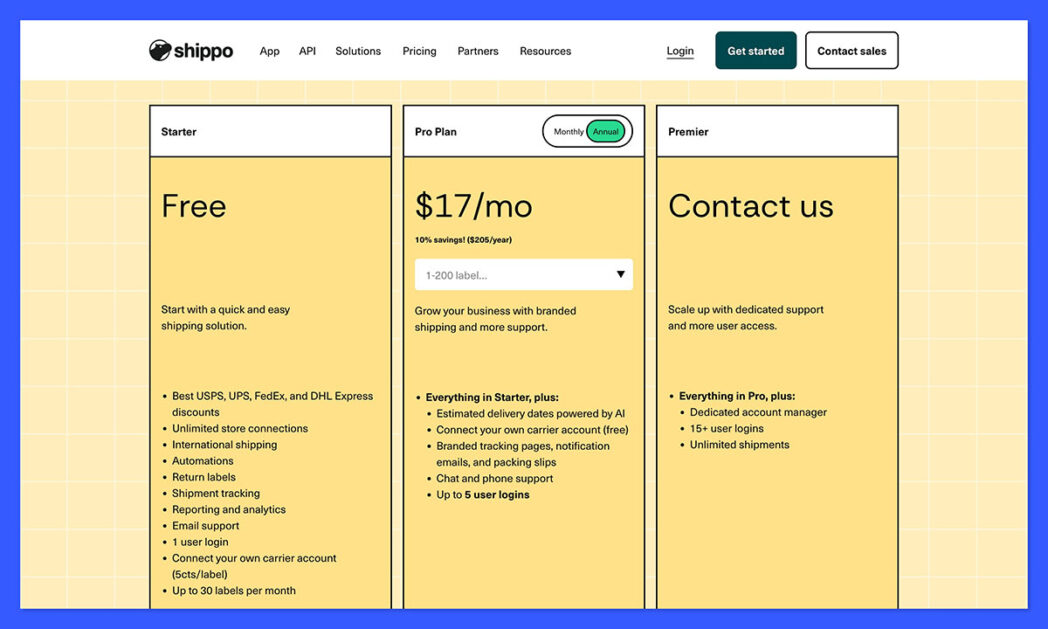
Shippo, on the other hand, offers a free plan, but introduces fees in two key ways:
- If you use your own carrier account (e.g., your own FedEx or UPS agreement), you’ll pay $0.05 per label
- Shippo’s best features, automation, branding, and batch processing, are locked behind its paid plans, starting at $10/month
If your priority is keeping shipping software overhead to zero, Pirate Ship is the clear winner.
While Shippo’s paid plans may be justifiable for growing operations, they can create unpredictable costs for new or smaller ecommerce businesses, especially those still learning to optimize shipping efficiency. Monthly subscriptions, per-label fees, and optional premium features can introduce additional expenses that add up fast when margins are tight or order volumes fluctuate seasonally.
Pirate Ship’s “postage-only” model remains highly attractive for stores that value predictability and simplicity. Unlike other platforms that bundle features behind paywalls, Pirate Ship’s transparent pricing structure removes the guesswork, allowing businesses to spend less time reviewing billing statements and more time fulfilling orders. For stores shipping under 500 packages per month, the savings can be substantial over time, especially when using USPS Cubic Pricing or discounted UPS Ground Saver rates.
Pricing Comparison Table
| Plan Type | Pirate Ship | Shippo |
|---|---|---|
| Free Plan | ✅ Yes (full access) | ✅ Yes, limited features |
| Paid Plans | ❌ None | ✅ $10+/mo (adds features) |
| Per-Label Fees | ❌ None | ✅ $0.05 per label (free plan) |
| API Access | ❌ No | ✅ Yes (free + paid) |
2. Best for Carrier Support: Shippo
🏆 Winner: Shippo
If you need to compare rates from more than just USPS or UPS, Shippo is the way to go.
Shippo supports over 40 domestic and international carriers, including:
- FedEx
- DHL Express
- Canada Post
- Australia Post
- Evri (UK)
- Correos (Spain)
By contrast, Pirate Ship only supports USPS and UPS, which is perfect for most U.S.-based sellers, but limiting for international reach or express delivery services.
For ecommerce brands selling to customers outside the United States, or even planning to expand globally in the future, Shippo’s multi-carrier support is a major competitive advantage. Being able to access both express and economy international services means businesses can offer multiple delivery speeds at checkout and choose the right carrier based on location, weight, and cost efficiency. This flexibility can increase conversions in global markets by offering better delivery expectations.
Even for domestic operations, Shippo’s broader carrier access helps when one carrier experiences delays, strikes, or service interruptions. Regional coverage via Canada Post, Sendle, or local courier partners can give Shippo users more resilience in their shipping strategy. For businesses shipping bulky items, temperature-sensitive products, or freight-based inventory, having the option to plug into different networks beyond USPS or UPS makes Shippo a future-proof choice.
International Support
- Pirate Ship offers Simple Export Rate for packages under 4 lbs, which is cost-effective but slower (1–4 weeks)
- Shippo lets you ship internationally via premium carriers like DHL and FedEx, giving you faster delivery options and more tracking capabilities
3. Best for Automation and Rules: Shippo
🏆 Winner: Shippo
Shippo gives growing businesses the tools they need to save time by automating shipping workflows. You can set:
- Shipping presets by product weight or type
- Rules that automatically choose the cheapest rate
- Package types and box sizes based on SKU
- Pre-filled customs forms for international orders
Pirate Ship is more manual by design. You can save a few presets or use batch label printing, but there’s no true automation engine. This keeps things simple but limits your ability to scale without extra labor.
Shippo’s automation capabilities are particularly valuable for businesses with high SKU counts, multiple fulfillment centers, or seasonal product bundles. For example, a store might create rules to route international orders to a specific warehouse or apply signature-required shipping only on orders over $200. These automations reduce the chance of human error while increasing consistency in how each order is packed and shipped.
Another underrated benefit is the time saved during training. When multiple team members are involved in fulfillment, Shippo’s automation ensures everyone follows the same logic and workflow, regardless of experience level. As operations grow, the ability to reduce friction in fulfillment without adding headcount or micromanaging each shipment is essential. For growing brands, this is where Shippo’s value becomes far more than just its carrier support.
4. Best for Branding and Post-Purchase Experience: Shippo
🏆 Winner: Shippo
Shippo allows paid users to create branded tracking pages, customize email notifications, and design packing slips that match your brand identity.
With Pirate Ship, you can edit your tracking email using custom HTML and enable email authentication (via DKIM), but there’s no native branded tracking page for customers. It works, but it’s not a polished, branded experience.
If you want a better unboxing and post-purchase journey, Shippo delivers more tools.
5. Best for Developer Features: Shippo
🏆 Winner: Shippo
If you need an API for your store or app, Shippo is the clear winner.
- Shippo’s REST API allows you to generate labels, track shipments, create return flows, and manage multi-warehouse logic
- There’s extensive documentation and client libraries for Python, Ruby, Node, and PHP
- Pricing is transparent, and the free tier includes basic API access
Pirate Ship has no API and makes that decision deliberately to focus on user-friendliness.
6. Best for Returns: Tie (Different Strengths)
🏆 Draw: Pirate Ship (Simple) vs Shippo (Customizable)
- Pirate Ship lets you print pay-on-use return labels, which means you can include them with outbound packages and only pay if they’re used
- Shippo supports return labels as well but goes further by allowing automated return flows through its dashboard or API
If you’re a solo shop just wanting to include an easy return label, Pirate Ship works well. For more structured or programmatic return processes, Shippo wins.
7. Best for Ecommerce Integrations: Shippo
🏆 Winner: Shippo
Both platforms integrate with major ecommerce tools like:
- Shopify
- WooCommerce
- BigCommerce
- Squarespace
- Wix
- Etsy
- CSV import/export
But Shippo supports more third-party logistics (3PLs), inventory management tools, and marketplaces natively, and its API makes it extensible if you’re running something custom.
For example, Shippo works well with tools like:
- Brightpearl
- Skubana
- Webgility
- Fulfillment by Amazon (FBA)
Pirate Ship’s integrations are limited to ecommerce platforms and spreadsheets, which covers most use cases but not all.
As your ecommerce business grows, it’s common to stack multiple systems, inventory management, customer support, accounting, and more. Shippo integrates easily with a variety of third-party tools that handle these functions, giving you a more connected backend that avoids duplicate data entry and manual syncing. This is especially useful for brands using multi-warehouse fulfillment or multi-channel selling.
Furthermore, Shippo’s ability to embed directly into other platforms via API means ecommerce apps, order management systems (OMS), and even white-label marketplaces can offer native shipping tools using Shippo’s engine. Pirate Ship, by contrast, is a standalone tool with limited integrations and no developer access, meaning you’ll rely more heavily on manual processes or Zapier-style middleware if you need to expand your workflow beyond the basics.
Final Verdict: Should You Choose Pirate Ship or Shippo?
Here’s our final breakdown by store size and need:
Choose Pirate Ship if:
- You want a 100% free tool with no monthly or per-label fees
- You ship primarily via USPS or UPS
- You only ship domestically or occasionally use the Simple Export Rate for small international orders
- You prefer a fast, simple tool without complex settings or integrations
Choose Shippo if:
- You need access to FedEx, DHL, or other international carriers
- You plan to automate shipping workflows or scale operations
- You want branded tracking pages and a polished post-purchase experience
- You’re a developer or platform embedding shipping into your software