Shopify and Haravan both promise the same thing: a fully hosted online store with multichannel selling built in. The difference is where they point that promise.
Shopify is a global commerce platform powering millions of businesses in over 175 countries, while Haravan is a Vietnam-first platform built around local marketplaces, payments, and tax compliance.
We compared both platforms on pricing, sales features, localization, app ecosystems, and support to help you pick the right one for your store.
The short answer: this comparison has two winners, depending on where you sell.
Shopify vs Haravan: Quick Verdict
Shopify is the better platform for stores with regional or global ambitions. Its app ecosystem, AI tooling, and multi-currency infrastructure are in a different league.
Haravan is the better platform for merchants selling only in Vietnam. It costs a fraction of Shopify’s price and ships with Shopee, Lazada, TikTok Shop, local payments, and Vietnamese e-invoice compliance out of the box.
Below, I break down where each platform wins, where each one frustrates, and the trap that catches merchants who pick based on price alone.
Quick Comparison: Shopify vs Haravan
| Dimension | Shopify | Haravan |
|---|---|---|
| Primary market | Global (175+ countries) | Vietnam |
| Entry price | $29/month (billed annually), Starter from $5/month | 300,000 VND/month (roughly $12), billed annually |
| Top-tier pricing | Shopify Plus from $2,300/month | Priority at 8,000,000 VND/month (roughly $305) |
| Free trial | 3 days, then $1/month for 3 months | 14 days |
| Marketplace integrations | Amazon, eBay, Etsy via Marketplace Connect | Shopee, Lazada, TikTok Shop, Tiki built in |
| App ecosystem | 8,000+ apps | 120+ apps |
| Themes | 190+ themes, global design standards | 400+ themes localized for Vietnamese retail |
| AI features | Shopify Magic, Sidekick assistant, AI-generated themes | Haravan AI Chat for customer service |
| Local compliance | Global tax tooling, VAT ID support via API | Vietnamese e-invoicing with direct tax authority connection |
| Best for | Cross-border and high-growth D2C brands | Vietnam-only SMEs and omnichannel retailers |
Key Takeaways
- Haravan wins on price for Vietnamese merchants. Its entry plan costs roughly a third of Shopify’s Basic plan, with VAT included and no transaction fees on top.
- Shopify wins everywhere else. If you sell beyond Vietnam, or plan to, Shopify’s multi-currency checkout, 8,000+ apps, and AI roadmap justify the higher cost.
- Watch the payment fees on Shopify. Shopify Payments is not available to merchants based in Vietnam, so local sellers pay third-party gateway fees plus Shopify’s own transaction fee on every order.
- Both lock you in. Neither platform gives you the source code. Migrating away means rebuilding, so pick for where your business will be in three years, not where it is today.
1. Best for Pricing: Haravan
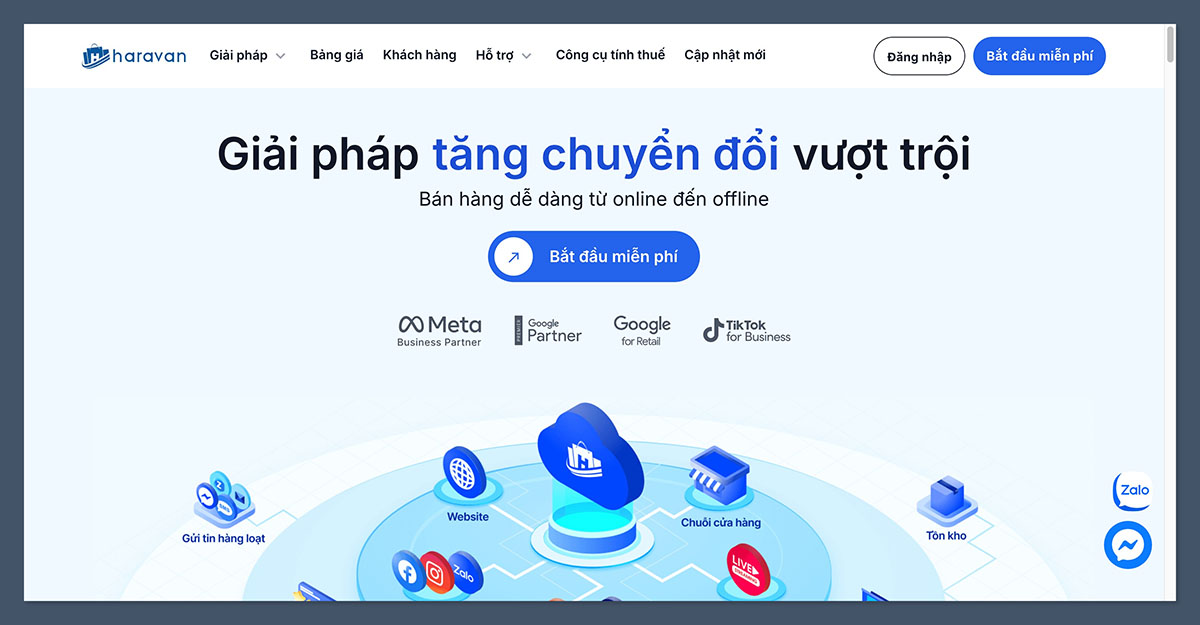
If you sell in Vietnam, Haravan is dramatically cheaper, and that gap is structural, not promotional.
Haravan’s plans are priced in VND, include VAT, and are billed annually. The current lineup looks like this:
| Haravan Plan | Monthly Price | Approx. USD | Includes |
|---|---|---|---|
| Standard | 300,000 VND | ~$12 | 10 staff accounts, 1 store, marketplaces, social selling, POS |
| Omni Pro | 680,000 VND | ~$26 | Adds ecommerce website, smart checkout, Open API, 2 stores |
| Omni Advanced | 800,000 VND | ~$31 | Adds livestream selling and automated order capture from comments |
| Grow | 1,500,000 VND | ~$57 | Adds customer segmentation, marketing automation, 25 staff, 5 stores |
| Scale | 3,000,000 VND | ~$115 | Adds loyalty points, membership tiers, chain-store fulfillment, 50 staff |
| Priority | 8,000,000 VND | ~$305 | Unlimited staff, dedicated servers, 1:1 support, priority SLAs |
Extra retail locations cost 200,000 VND per month, and livestream selling can be added to lower plans for 300,000 VND per month. USD figures are approximate and shift with the exchange rate.
Shopify’s core plans are priced in USD:
| Shopify Plan | Annual Billing | Monthly Billing | Best For |
|---|---|---|---|
| Starter | $5/month | Selling via links and social, no full storefront | |
| Basic | $29/month | $39/month | New stores and solo sellers |
| Grow | $79/month | $105/month | Growing teams needing more staff accounts and reports |
| Advanced | $299/month | $399/month | Scaling stores needing custom reporting and lower card rates |
| Shopify Plus | From $2,300/month (3-year term) | High-volume enterprise brands | |
Shopify softens the entry with a 3-day free trial followed by 3 months at $1 per month, which is a genuinely useful runway for launching. Haravan counters with a longer 14-day trial but requires annual payment once you commit, so there is no month-to-month option to fall back on.
The hidden cost sits in payments. Shopify Payments, the native gateway that waives Shopify’s transaction fees, is not available to Vietnam-based merchants. That means local sellers on Shopify pay their third-party gateway’s processing rate plus Shopify’s additional transaction fee, up to 2% per order on the Basic plan.
On a store doing meaningful volume, that quietly doubles the real cost gap between the two platforms. Haravan charges no platform transaction fees and integrates VNPay, Momo, ZaloPay, and ShopeePay directly.
The Winner: Haravan is far cheaper for Vietnamese merchants
A Haravan Omni Pro plan costs about a third of Shopify Basic before you even count Shopify’s transaction fees. For a Vietnam-only store, the math is not close.
2. Best for Selling in Vietnam: Haravan
Haravan was built around one specific reality: Vietnamese commerce happens on marketplaces, social media, and livestreams as much as on standalone websites. The platform reflects that at every level.
Marketplace connections to Shopee, Lazada, TikTok Shop, and Tiki are native, with synced inventory, order confirmation inside the Haravan admin, and revenue reports that account for each marketplace’s fees.
Social selling runs through Harasocial, which manages Facebook pages, Zalo, Instagram, and TikTok for Business conversations in one inbox, creates orders mid-chat, and auto-replies to comments.
The livestream tooling is the standout. On Omni Advanced and above, Haravan automatically captures orders from comment syntax during Facebook livestreams, checks stock in real time, sends confirmation messages, and merges thousands of orders from repeat buyers across streams. For the comment-to-cart selling style that dominates Vietnamese social commerce, Shopify simply has no native equivalent.
Compliance is the other quiet advantage. Haravan handles Vietnamese VAT setup and issues e-invoices across every channel, with data transmitted directly to the tax authority. As Vietnam tightens e-invoice enforcement for online sellers, this is becoming a genuine operational requirement rather than a nice-to-have.
Logistics round it out: 15+ integrated local carriers including Giao Hang Nhanh, ViettelPost, GrabExpress, and Ahamove, with negotiated discounts of up to 30% and side-by-side rate comparison at fulfillment.
The Winner: Haravan owns the Vietnamese sales stack
Native Shopee, Lazada, and TikTok Shop sync, livestream order capture, local carriers, and tax-authority-connected e-invoicing make Haravan the operationally safer choice for domestic selling.
3. Best for Global Selling: Shopify

Shopify supports translated storefronts in 20+ languages, sells in multiple currencies with localized pricing per market, and keeps expanding its cross-border toolkit: market-specific discounts, mixed shipping and pickup in a single order, and customer VAT ID handling through the Admin API for B2B workflows.
If you want to sell to buyers in the US, Europe, or across ASEAN, this infrastructure already exists and is battle-tested at enormous scale.
Haravan, by contrast, is structurally domestic. Its marketplace integrations, payment gateways, carriers, and compliance tooling all assume a Vietnamese operation. International cards via PayPal and Visa/Mastercard are supported, but there is no multi-market storefront system, no localized pricing engine, and no international tax tooling. A Haravan merchant who lands product-market fit abroad will almost certainly need to replatform.
That replatforming risk deserves weight in the decision. Both platforms are closed SaaS: you rent the software, you never own the code, and leaving means rebuilding your store, migrating data, and retraining your team. Choosing Haravan to save money and then outgrowing Vietnam within two years can cost more than starting on Shopify would have.
The Winner: Shopify is built for borders
Multi-language storefronts, multi-currency checkout, and maturing international tax tooling make Shopify the only sensible pick for cross-border ambitions.
4. Best App Ecosystem and AI: Shopify
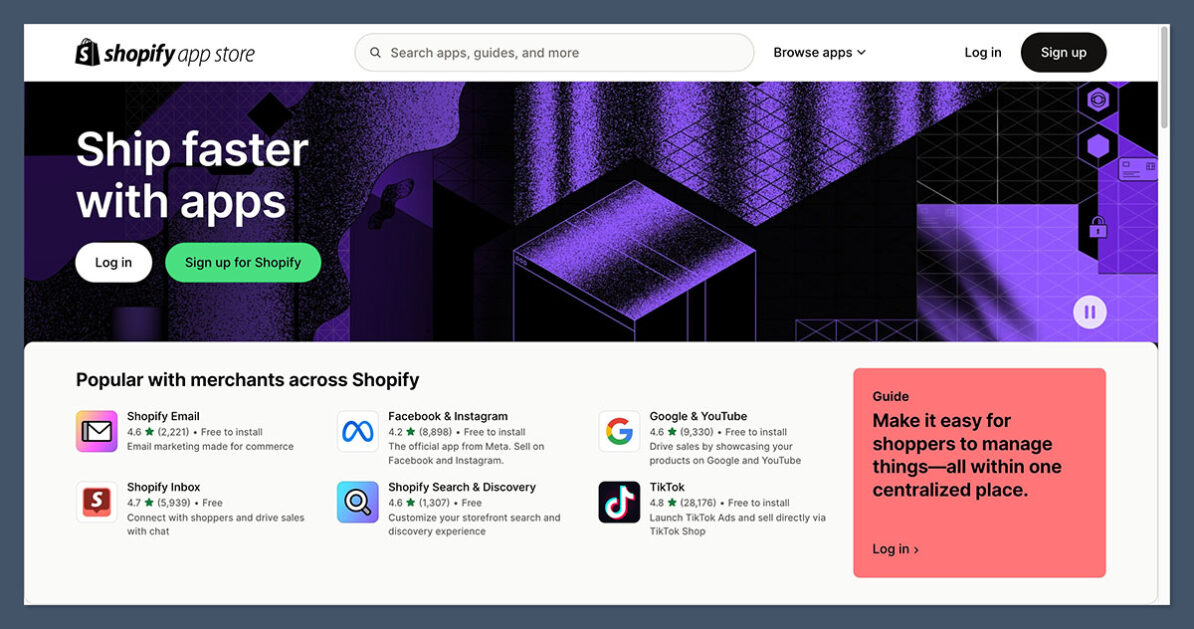
Shopify’s app store hosts more than 8,000 third-party apps covering everything from subscriptions and bundles to ERP connectors and review platforms, backed by a global network of partner agencies and developers.
Haravan’s app store sits at around 120 apps plus roughly 50 implementation services, almost all oriented toward the Vietnamese market.
That gap matters less than it sounds for a simple store, because Haravan builds more into its plans: POS, social inbox, chatbot marketing, loyalty, and marketplace sync are all native rather than app-dependent. A Shopify merchant assembling the same stack from apps can easily add $50 to $200 per month in app subscriptions on top of the base plan.
But on AI and platform innovation, the distance is widening. Shopify ships AI-generated themes, Shopify Magic for product descriptions, the Sidekick AI assistant for store management, and an aggressive developer roadmap including next-generation events and a storefront catalog built for agent-driven commerce. The platform is clearly positioning itself for a future where AI agents browse, compare, and buy on behalf of customers.
Haravan is not standing still: it offers Haravan AI Chat, a 24/7 AI assistant for multichannel customer service and order closing, and its recent releases focus on performance and multichannel selling improvements. It is a pragmatic, incremental path, but it is not the platform-level AI investment Shopify is making.
The Winner: Shopify, by an order of magnitude
8,000+ apps versus 120, plus a platform-level AI strategy, give Shopify far more headroom for stores with complex or evolving needs.
5. Ease of Use, Design, and Support: It Depends on Your Language
Both platforms are fully hosted, include free SSL and unlimited bandwidth, and use section-based editors rather than freeform drag-and-drop.
A basic Haravan store can go live in under an hour using its 400+ localized themes, which are tuned to Vietnamese retail conventions like QR payment confirmation and COD-heavy checkout flows. Shopify offers fewer themes overall, around 190+, but with broader industry coverage and a deeper bench of premium designers, and its admin is available in Vietnamese.
Support is where the audiences split cleanly. Shopify runs 24/7 support through an AI-powered chat assistant with escalation to human advisors, plus an extensive help center, though phone support is reserved for Plus merchants.
Haravan offers Vietnamese-language support by hotline seven days a week from 8am to 9pm, onboarding assistance during the trial, and 1:1 dedicated support with sub-30-minute response times on its Priority plan.
For a Vietnamese merchant whose team works in Vietnamese, Haravan’s support experience will feel materially better. For everyone else, Shopify’s round-the-clock coverage and vast documentation win.
The Winner: Haravan for Vietnamese-speaking teams, Shopify for everyone else
Pick the platform whose support team speaks your language, literally. Day-to-day usability is comparable on both.
How We Compared Shopify and Haravan
We evaluated both platforms across six weighted criteria, using current official pricing pages, platform documentation, and feature changelogs as primary sources:
| Criteria | Weight | What We Assessed |
|---|---|---|
| Sales features | 30% | Multichannel selling, marketplace sync, checkout, POS, livestream commerce |
| Value for money | 20% | Plan pricing, transaction fees, included features versus app costs |
| Localization and compliance | 15% | Payments, carriers, tax and e-invoice tooling for the target market |
| Ecosystem and extensibility | 15% | App store depth, APIs, developer platform, AI capabilities |
| Ease of use and design | 10% | Onboarding, admin experience, theme quality and variety |
| Help and support | 10% | Channels, availability, language coverage, documentation |
Shopify vs Haravan: Our Winner
For most stores reading a comparison like this one, Shopify is the stronger platform.
Its app ecosystem, AI investment, and international infrastructure give growing brands room to scale in any direction, and the $1-per-month introductory period makes trying it nearly free.
But if your business sells exclusively in Vietnam, Haravan is the smarter buy, and it is not a consolation prize. It is cheaper by a wide margin, avoids Shopify’s transaction fee problem for Vietnamese merchants, and solves problems Shopify does not even attempt: livestream order capture, Shopee and TikTok Shop sync, and e-invoicing connected directly to the tax authority.
The honest decision rule is a single question: will you sell outside Vietnam within the next three years? If yes, start on Shopify and skip a painful migration later.
If no, Haravan gives you a better-fitted toolkit at a fraction of the cost. Both offer free trials, so run your real catalog through each before committing, especially since Haravan requires an annual contract upfront.
Frequently Asked Questions
Is Haravan cheaper than Shopify?
Yes, substantially, for merchants in Vietnam. Haravan’s entry plan costs 300,000 VND per month (roughly $12) with VAT included and no platform transaction fees, while Shopify Basic costs $29 per month billed annually plus transaction fees for Vietnamese merchants who cannot use Shopify Payments. Note that Haravan bills annually, so the lower monthly figure still requires a yearly commitment.
Can I use Shopify in Vietnam?
Yes. Shopify works in Vietnam and offers a Vietnamese admin interface. The main limitations are that Shopify Payments is unavailable, so you pay extra transaction fees on third-party gateways, and integrations with Shopee, Lazada, TikTok Shop, local carriers, and Vietnamese e-invoicing require third-party apps rather than working out of the box.
Does Haravan work for selling internationally?
Only in a limited way. Haravan supports international payments through PayPal and Visa/Mastercard, but it lacks multi-language storefronts, multi-currency pricing, and international tax tooling. Businesses with serious cross-border plans typically choose Shopify or another globally oriented platform instead.
Which platform is better for livestream selling?
Haravan, clearly. Its Omni Advanced plan and above automate the entire Facebook livestream workflow: capturing orders from comments, checking inventory, confirming via message, and merging duplicate orders. Shopify has no comparable native feature, and third-party livestream apps do not match Haravan’s depth for the Vietnamese comment-selling format.
Do I own my store if I leave Shopify or Haravan?
No. Both are closed SaaS platforms, meaning you never own the source code. You can export your product and customer data, but leaving either platform means rebuilding your storefront elsewhere. That makes the initial platform choice more consequential than the monthly price difference suggests.
Does Haravan offer a free trial?
Yes, Haravan offers a 14-day free trial with onboarding support included. Shopify’s trial is shorter at 3 days, but it is followed by an introductory offer of $1 per month for your first 3 months, which gives you a longer low-cost runway overall.