Shopify and Faire come up in the same conversations about selling to retailers, but they solve very different problems.
Shopify is an ecommerce platform you run your business on. Faire is a wholesale marketplace where independent retailers come to buy inventory.
After digging into both platforms, their pricing, and the deepening partnership between the two companies, the honest answer is that this is less of a head-to-head fight and more a question of which one your business actually needs, and whether you should be using both.
In this comparison, I’ll break down where each platform wins on pricing, direct-to-consumer selling, wholesale, customer acquisition, and how well they work together, so you can decide where your money and time should go.
Shopify vs Faire: Quick Verdict
- Shopify: Best for running your own store, ideal if you want full control over your brand, pricing, and customer data across DTC, B2B, and in-person sales
- Faire: Best for wholesale growth, ideal if you want to reach over 100,000 brands’ worth of retail demand without building a wholesale sales team
The twist is that since Shopify took an equity stake in Faire and named it its recommended wholesale marketplace, the two platforms have been built to plug into each other. For many brands, the strongest setup is Shopify as the operational backbone with Faire bolted on as a wholesale channel.
Quick Comparison: Shopify vs Faire
| Dimension | Shopify | Faire |
|---|---|---|
| What it is | Ecommerce platform for DTC, B2B, and POS | Wholesale marketplace and B2B network |
| Who it serves | Merchants of all sizes selling on their own channels | Brands selling wholesale and independent retailers buying inventory |
| Pricing model | Monthly subscription from $29/month (billed annually) plus payment processing | Free to join, 15% commission on marketplace orders, 0% on Faire Direct orders |
| Who brings the traffic | You do; Shopify provides the tools | Faire does; the marketplace is the channel |
| Customer data | You own it | Faire controls the network; you see buyer details in context |
| POS | Shopify POS, the preferred POS for Faire retailers | No POS of its own; integrates with Shopify POS |
| Free trial | 3-day trial, then $1/month for 3 months | Free to list; you only pay when you sell |
Key Takeaways
- Shopify is a commerce operating system; Faire is a wholesale demand network. They compete for your budget, not for the same job.
- Shopify costs $29 to $299 per month (billed annually) for its core plans, plus payment processing fees.
- Faire is free to join and takes a 15% commission on marketplace orders, with a one-time $10 new customer fee for North American brands. Orders through your own Faire Direct link carry 0% commission.
- Since late 2023, Shopify has held an equity stake in Faire, and dedicated Faire buyer and seller apps now sync catalogs, inventory, orders, and pricing between the two platforms.
- Most growing product brands end up using Shopify for operations and Faire for wholesale reach, rather than choosing one over the other.
Best for Pricing: It Depends on Your Model
Comparing the two on price is comparing a subscription to a commission, so the right question is which cost structure fits your margins.
Shopify charges a fixed monthly fee regardless of how much you sell, plus payment processing on each transaction:
- Basic: $29/month billed annually ($39 billed monthly), with 2.9% + 30¢ per online card transaction via Shopify Payments; a full store with unlimited products and up to 2 staff accounts
- Grow: $79/month billed annually ($105 billed monthly), with 2.7% + 30¢ card rates; adds more reporting, automation, and up to 5 staff accounts
- Advanced: $299/month billed annually ($399 billed monthly), with 2.5% + 30¢ card rates; adds custom reporting and up to 15 staff accounts for scaling stores
- Plus: from $2,300/month for enterprise brands that need custom checkout and advanced B2B features
Shopify’s free trial lasts just three days, but the $1/month introductory deal for your first three months gives you a low-risk runway to test it properly.
Faire flips the model. There are no monthly fees and no listing fees. You pay only when an order comes in:
- Marketplace orders: 15% commission on the product subtotal when a retailer discovers you through Faire
- New customer fee: a one-time $10 fee on a retailer’s first order with your brand (for North American brands); reorders drop back to the flat 15%
- Brands outside North America: a 10% referral fee on top of the standard commission applies to first marketplace orders, making the first-order rate 25%, with reorders at 15%
- Faire Direct: 0% commission on orders from retailers you invite through your own link, so your existing wholesale accounts can use Faire’s tools without the marketplace cut
- Payment processing: roughly 1.9% to 3.5% plus $0.30 depending on how fast you want your payout
For a brand doing low wholesale volume, Faire is effectively free until it works. For a brand pushing serious wholesale revenue through the marketplace, that 15% take rate becomes a real margin conversation, and that’s exactly when moving existing accounts to Faire Direct, or onto Shopify’s own B2B features, starts to pay off.
The Winner: It’s a tie, because the cost structures suit different stages
Faire’s commission-only model is cheaper to start; Shopify’s flat subscription is cheaper at scale. Smart brands use Faire’s marketplace for discovery and shift repeat wholesale relationships to lower-cost channels over time.
Best for Selling Direct to Consumers: Shopify

This one isn’t close, because Faire doesn’t even enter the ring. Faire is wholesale only; consumers can’t buy there, and retailers must be verified businesses to shop.
Shopify, meanwhile, remains the benchmark for DTC selling.
You get a full storefront, checkout, and payments stack, over 190 templates, multichannel selling across social platforms and marketplaces, and an app store with thousands of integrations for subscriptions, bundles, loyalty, and marketing automation. Crucially, you own your customer data and control your branding and pricing end to end.
Shopify Pros
- Complete control over storefront, checkout, pricing, and customer relationships
- Sells across web, social, marketplaces, and in person from one backend
- Huge app ecosystem to extend functionality as you grow
Shopify Cons
- You bring your own traffic; the platform doesn’t supply demand
- App costs stack up on top of your subscription
The Winner: Shopify, by default and by merit
Faire doesn’t do DTC at all, and even among platforms that do, Shopify’s storefront, checkout, and app ecosystem are the strongest combination for consumer sales.
Best for Wholesale: Faire
Here the tables turn. Shopify does offer native B2B features, including customer-specific pricing, payment terms, and wholesale catalogs (and as of recent updates, B2B functionality has expanded beyond just Plus merchants).
But Shopify’s B2B tooling assumes you already have wholesale buyers. It gives you the machinery, not the demand.
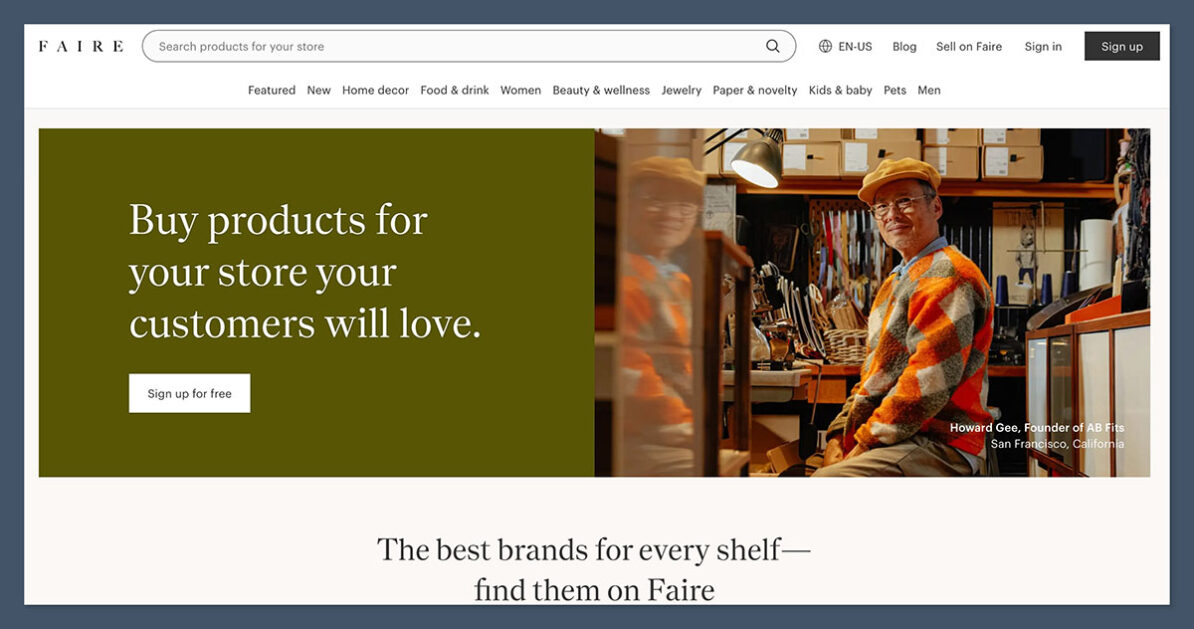
Faire was purpose-built for wholesale. The platform connects over 100,000 brands with hundreds of thousands of independent retailers worldwide, and it handles the parts of wholesale that brands hate most:
- Net terms without the risk: eligible retailers get 60-day payment terms, but Faire pays you on schedule and absorbs the credit risk, so you’re not chasing invoices
- Buyer trust: retailer verification, payment protection, and free returns on first orders lower the barrier for shops to try a new brand
- Wholesale workflows: order minimums, case packs, linesheets, and reorder tools come standard instead of being bolted on through apps
Faire Pros
- Built-in access to a massive, active network of verified retail buyers
- Faire takes the credit risk on net terms and guarantees your payment
- No upfront cost; you pay only when wholesale orders land
Faire Cons
- 15% commission on marketplace orders cuts into already-thin wholesale margins
- Faire owns the buyer relationship and network data, not you
- Standing out among 100,000+ brands requires active effort on imagery, responsiveness, and assortment
The Winner: Faire wins wholesale on demand, not just tooling
Shopify gives you B2B features; Faire gives you B2B buyers. For most independent brands, the buyers are the hard part.
Best for Finding Customers: Faire (With a Catch)
The structural difference between the two platforms comes down to one question: who brings the traffic?
With Shopify, the answer is you. Shopify provides excellent tools, from SEO features and the Semrush-powered Ecommerce Booster app to email marketing and social channel integrations, but every visitor to your store is one you earned through marketing, ads, or organic reach.
Faire is the opposite: the marketplace itself is the acquisition channel. Retailers come to Faire specifically to discover new products, browsing a catalog of nearly 10 million items.
For a small brand, that’s exposure to wholesale buyers that would otherwise require trade shows, cold outreach, or a dedicated sales rep.
The catch is the trade-off every marketplace imposes. Faire’s algorithm decides who sees you, the commission is the toll for the demand, and the retailer technically belongs to Faire’s network. Brands that rely entirely on marketplace discovery are renting their wholesale channel, which is why pairing Faire with owned channels matters.
The Winner: Faire for acquisition, Shopify for ownership
Faire delivers buyers you didn’t have to find; Shopify lets you keep the relationships you build. The strongest position is using the first to feed the second.
Best Together: The Shopify and Faire Partnership
The most important development in this comparison is that Shopify and Faire stopped circling each other and joined forces.
In late 2023, Shopify took an equity stake in Faire and named it the recommended wholesale marketplace for Shopify merchants, with the stated goal of expanding Shopify’s B2B offering and unifying online and in-person retail for independent businesses.
That partnership turned into real product. In 2024, Faire launched dedicated apps in the Shopify App Store, one for each side of the marketplace:
- Faire seller app (for brands): pair your Shopify and Faire accounts in a few clicks, import your catalog from Shopify so there’s no manual linesheet building, sync inventory in real time to prevent overselling, keep wholesale pricing aligned with your Shopify pricing, and pull Faire orders into Shopify for unified fulfillment and reporting
- Faire buyer app (for retailers): discover and reorder products from Faire’s catalog inside Shopify, with purchased inventory syncing straight into your Shopify store and POS so it’s ready to sell online and in person
You can also embed your Faire wholesale shop into your Shopify site navigation, and Faire has signaled more to come: a Faire Direct widget aimed at 0% commission on qualifying orders, a Faire-powered stockist map for brand websites, and more flexible ways to sync Faire-ordered products into Shopify POS.
The practical timeline looks like this: basic order and inventory sync arrived in 2021, the equity stake and strategic partnership landed in 2023, and the dedicated buyer and seller apps with deeper POS alignment followed in 2024. Each step has made running both platforms from one backend less of a workaround and more of an intended setup.
The Winner: Both, and that’s the point
Shopify and Faire are now a vertically linked stack: Shopify for operations and owned channels, Faire for wholesale demand. The integration is official, deep, and improving.
Which Should You Choose?
If you’re a brand selling your own products
- Choose Shopify only if DTC is your focus and wholesale is a someday problem. You can add basic B2B features later without leaving the platform.
- Choose Faire only if wholesale is your entire business and you don’t need a consumer-facing store yet. It’s the cheapest way to test wholesale demand, since you pay nothing until orders arrive.
- Choose both if you’re a hybrid brand. Run Shopify as your source of truth for catalog, inventory, and reporting, and treat Faire as a wholesale discovery channel that syncs into it. Use Faire Direct for accounts you bring yourself to avoid the commission.
If you’re an independent retailer
- Choose Shopify for your own online store and POS, especially since Shopify POS is now the preferred POS for Faire’s retail community.
- Use Faire as your sourcing destination. With the buyer app, products you order on Faire flow directly into your Shopify catalog and POS, ready to sell.
How We Compare Ecommerce Platforms
To keep comparisons like this consistent, we assess platforms across weighted criteria based on what matters most to sellers:
| Criteria | Weight | What we look at |
|---|---|---|
| Sales features | 40% | Core selling capabilities, B2B and wholesale tools, channel reach |
| Pricing and fees | 20% | Subscriptions, commissions, processing fees, and total cost at different volumes |
| Integrations | 15% | How well the platform connects to the rest of a seller’s stack |
| Ease of use | 10% | Onboarding, dashboard clarity, day-to-day workflows |
| Support | 10% | Channels, availability, and quality of help resources |
| Data ownership | 5% | Who controls customer relationships and information |
For this comparison, we also verified current pricing directly against both companies’ published rates, since fee structures on both platforms have changed in recent years.
Shopify vs Faire: Our Verdict
If you force the question, Shopify is the more complete platform: it can run DTC, B2B, and in-person retail, and with its B2B features expanding, it can technically do wholesale on its own.
Faire can’t replace Shopify, but Shopify can’t replicate what Faire actually sells, which is access to a dense, active network of independent retail buyers.
So the real verdict is this: Shopify is the operating system, Faire is a channel.
If you only have budget and bandwidth for one, pick based on where your revenue comes from. If you’re building a brand that sells both to consumers and to shops, the integrated Shopify-plus-Faire stack is now the path of least resistance, and the two companies are clearly investing to keep it that way.
FAQ
Is Faire a competitor to Shopify?
Not really. Shopify is an ecommerce platform you build your store on; Faire is a wholesale marketplace where retailers buy inventory. They overlap slightly on B2B selling, but since Shopify’s equity investment in Faire and the launch of official integration apps, they function as partners rather than rivals.
How much does Faire cost compared to Shopify?
Faire is free to join and charges a 15% commission on marketplace orders, plus a one-time $10 new customer fee on a retailer’s first order for North American brands (brands outside North America pay a 25% first-order rate, then 15% on reorders). Shopify charges a monthly subscription from $29/month (billed annually) plus payment processing fees, with no commission on your sales.
Can I use Shopify and Faire together?
Yes, and it’s increasingly the intended setup. The Faire seller app syncs your Shopify catalog, inventory, pricing, and orders with Faire, while the buyer app lets retailers pull Faire purchases straight into their Shopify store and POS.
What is Faire Direct?
Faire Direct is your personalized link for inviting retailers you already work with onto Faire. Orders placed through it carry 0% commission, so you get Faire’s order management, payment terms, and protection on your existing accounts without paying the marketplace cut.
Do customers buy directly from Faire?
No. Faire is wholesale only. Buyers must be verified retail businesses, and they purchase at wholesale prices to resell in their own shops. If you want to sell to consumers, you need your own channel, which is where Shopify comes in.
Does Shopify own Faire?
No. Shopify took a minority equity stake in Faire in late 2023 as part of a strategic partnership, but Faire remains an independent company. The partnership made Faire Shopify’s recommended wholesale marketplace and Shopify POS the preferred POS for Faire retailers.