Amazon Merch on Demand is one of the few print-on-demand programs where you can put your designs in front of millions of shoppers without running a single ad or building a store from scratch.
That built-in audience is genuinely valuable. But it comes with real trade-offs: limited branding control, an opaque approval process, upload caps that slow early growth, and margins set entirely by Amazon.
Our research team has spent hours reviewing the platform, testing the workflow, and comparing it against other print-on-demand options. In this review, I’ll walk through how Amazon Merch on Demand works, what it costs, where it excels, and where it falls short, so you can decide whether it belongs in your ecommerce strategy.
Why you can trust this review
We’ve conducted in-depth research across the print-on-demand landscape, covering platforms, royalty structures, and seller experiences to give you accurate and unbiased assessments.
Our goal is to help you find the right channel for your business, not to push you toward any particular platform.
Quick Verdict, Pros and Cons
Quick Verdict: Amazon Merch on Demand is a legitimate, low-risk channel for designers and brand builders who want to tap into Amazon’s organic demand without managing inventory. It works best as part of a broader strategy rather than a standalone business, and rewards patient, consistent sellers who can navigate a competitive marketplace.
Pros
- Access to Amazon’s massive, built-in traffic
- No inventory or upfront product costs
- Amazon handles printing, shipping, and returns
- Products are Prime-eligible from day one
- Sell across multiple global Amazon marketplaces
Cons
- Invitation/approval-only with no guaranteed timeline
- Very limited branding and packaging control
- Slow early upload tiers restrict design testing
- Royalty structure and base costs set by Amazon
- Extremely competitive niches
What Is Amazon Merch on Demand?
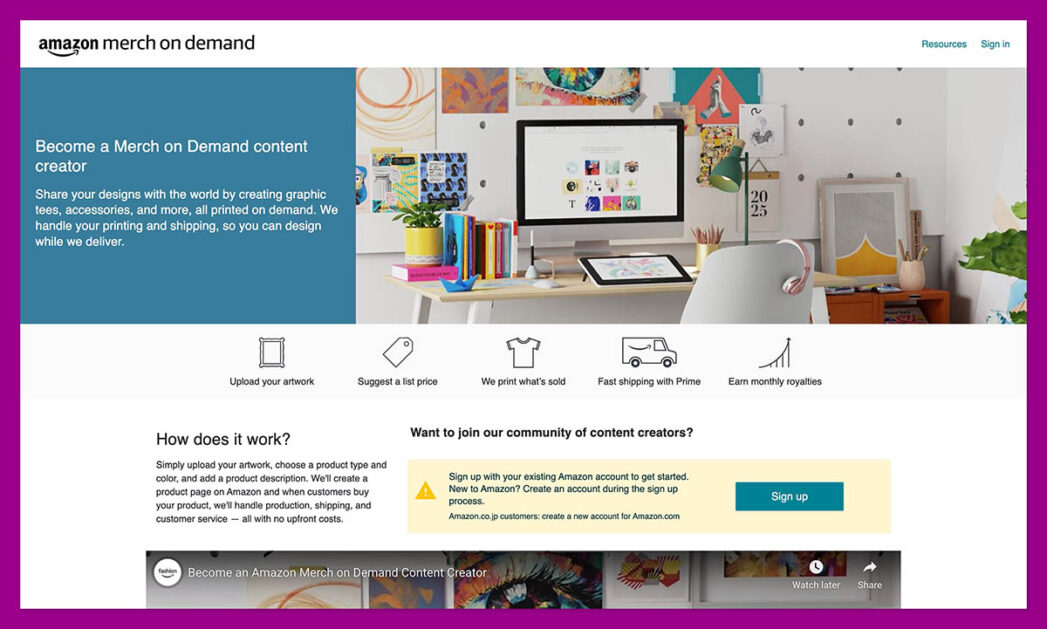
Amazon Merch on Demand is Amazon’s native print-on-demand program. You upload your designs, select products, set a price, and write your listings.
Amazon then handles everything else: printing, fulfillment, shipping, returns, and customer service. You earn a royalty on each sale.
The product catalog covers core apparel and accessories, including t-shirts, hoodies, sweatshirts, phone cases, and PopSockets. Listings can appear across multiple Amazon marketplaces, including the US, five European markets, and Japan, and all products are Prime-eligible by default.
Importantly, this is not a traditional seller account. You don’t operate an FBA or FBM storefront in the usual sense. Your designs live inside Amazon’s ecosystem, under Amazon’s control. Your role is limited to creating designs, writing listings, and setting prices.
Amazon Merch on Demand sits in an interesting middle ground: you get the reach of the world’s largest ecommerce platform, but you give up most of the control that comes with running your own store. Whether that trade-off works for you depends entirely on your goals.
How Amazon Merch on Demand Works
Getting started with Merch on Demand requires an application and approval, which is the first hurdle many sellers encounter.
The review process is invitation-based, the timeline is unpredictable, and there’s no guarantee of acceptance. Once approved, you’re placed into a tiered system that governs how many designs you can have live at any given time.
The Tier System
New sellers start at the lowest tier, commonly Tier 10, which gives you 10 live design slots. As you make sales and fill your available slots, you unlock higher tiers with more capacity.
Amazon has updated its tiering rules over time, shifting from a purely lifetime-sales-based model to one that considers both the number and percentage of products sold in the last 12 months. This pushes sellers toward consistent, ongoing performance rather than relying on occasional spikes.
The practical effect is that early growth is deliberately slow. Unlike other POD platforms where you can upload hundreds of designs on day one and test at scale, Merch requires you to earn your way to greater capacity.
Royalties and Payouts
Your earnings per sale are calculated as your list price minus Amazon’s base cost, which covers production, fulfillment, and Amazon’s fees. The remainder is your royalty. Higher list prices generally produce higher per-unit royalties, but you have to stay price-competitive within your niche.
Royalties are displayed in your dashboard shortly after sales occur, but payouts typically arrive approximately 60 days after month-end to account for returns and processing. Most sellers will encounter a minimum payout threshold of around 100 in their local currency.
Top Tip: Because tiering now weighs recent performance, focus on getting your early designs to convert before uploading new ones. A smaller number of optimized, selling designs will move you up the tiers faster than a large library of untested uploads.
Getting Started With Amazon Merch on Demand
The first step is applying through the Merch on Demand portal. You’ll submit basic information about yourself and your intended use case, then wait for Amazon to review and approve your application. There’s no defined timeline for this process, which can be frustrating if you’re trying to plan a product launch around it.
Once approved, setup is relatively straightforward. You upload your artwork, select the products you want to apply it to, set a list price, and write a product title and bullet points.
Amazon generates the listing and makes it live. From that point, your main levers are design quality, listing optimization, keyword research, and pricing.
The onboarding experience is minimal compared to platforms like Printful or Printify, which offer more guidance on product selection and design setup.
Merch assumes you already know what you’re doing, so beginners should invest time in learning the basics of Amazon keyword research and listing optimization before diving in.
Selling on Amazon Merch on Demand
The core selling proposition of Merch on Demand is access: access to Amazon’s traffic, Amazon’s Prime badge, and Amazon’s customer trust. This is what separates it from most other POD platforms and makes it worth taking seriously despite its limitations.
Traffic and Prime Eligibility
Every Merch listing is Prime-eligible from day one, which means customers get fast, free shipping as part of their Prime membership. This is a significant conversion driver that standalone POD stores simply cannot match without building significant brand equity first. You’re essentially borrowing Amazon’s trust to sell your designs.
Global Marketplace Reach
Merch on Demand supports listings across multiple Amazon marketplaces, including the US, UK, Germany, France, Italy, Spain, and Japan. This gives you passive international distribution without having to manage separate storefronts, shipping logistics, or currency conversions.
Analytics and Data
Amazon’s Merch dashboard provides sales data, conversion insights, and keyword performance information. This is more useful than it might sound: the keyword data can inform your broader Amazon strategy, and conversion patterns can tell you which design styles or niches are resonating before you invest in them more heavily on other channels.
Multichannel Potential
While Merch itself is a closed ecosystem, it works well as a low-overhead test bed. Designs that perform well on Merch can be validated before you invest in them through a full POD integration on Shopify or a private-label line. The zero-inventory model means you’re risking time on design and listing work, not capital on stock.
Designing for Amazon Merch on Demand
The product catalog on Merch on Demand skews toward mass-market, everyday apparel and accessories. T-shirts, hoodies, and sweatshirts make up the bulk of volume, with phone cases and PopSockets rounding out the catalog. If you’re chasing high-end apparel, specialty materials, or a premium brand positioning, you’ll find the catalog limiting.
Design requirements are standard across print-on-demand: transparent PNG files at the correct dimensions for each product type. Amazon provides templates and size guides for each product.
The design upload process itself is simple, but the creative constraints are real: you cannot customize labels, tags, packaging, or any physical aspect of the product beyond the printed artwork.
For creators building a premium or distinctive brand, the lack of custom packaging and labeling is a genuine barrier.
You’re selling a printed product inside an Amazon white-label experience, which makes it very difficult to create a memorable unboxing or brand moment for your customers.
Amazon Merch on Demand Pricing and Royalties
There are no upfront fees or monthly subscriptions to use Amazon Merch on Demand. You earn royalties on each sale, calculated as your list price minus Amazon’s base cost. The base cost covers production and fulfillment and is set by Amazon, meaning your only real pricing lever is the list price you choose.
| Product Type | Who Sets the Price | Your Royalty | Base Cost |
|---|---|---|---|
| T-Shirts | You (within Amazon’s range) | List price minus base cost | Set by Amazon |
| Hoodies / Sweatshirts | You (within Amazon’s range) | List price minus base cost | Set by Amazon |
| Phone Cases | You (within Amazon’s range) | List price minus base cost | Set by Amazon |
| PopSockets | You (within Amazon’s range) | List price minus base cost | Set by Amazon |
Experienced sellers typically report effective royalty margins of around 15 to 25% on well-priced products, though this varies significantly by product type and list price. Higher list prices generally improve your per-unit royalty, but pricing too high above market rate in competitive niches will hurt your conversion rate and organic ranking.
Payouts are processed roughly 60 days after month-end and require a minimum balance in your local currency before funds are released. There are no transaction fees, no subscription costs, and no app fees, which keeps the total cost of using the program effectively zero beyond your time investment.
Top Tip: Research competitor pricing before setting your list price. In popular niches, the spread between the lowest and highest priced similar designs is often narrow. Pricing at the higher end of the competitive range only works if your design quality and listing optimization can justify it.
The Competitive Reality of Amazon Merch on Demand
The Merch on Demand catalog is enormous and extremely crowded. Popular niches, such as novelty humor, holiday gifts, hobbies, and professions, are saturated with designs from thousands of sellers. Standing out requires genuine investment in niche research, keyword strategy, and design quality.
Amazon also enforces strict intellectual property and trademark compliance rules. Designs that infringe on existing trademarks, even inadvertently, will be removed and can jeopardize your account. Sellers need to conduct trademark checks before uploading any design containing text or recognizable phrases.
Limited Promotional Tools
One of the more frustrating constraints of Merch on Demand is the lack of native promotional tools. You cannot run your own discount campaigns or coupons for Merch listings in the same way you can on a self-hosted store. You can drive external traffic to your listings and some Amazon advertising options are available, but your marketing toolkit is significantly more limited than what you’d have with a Shopify or WooCommerce store.
Is Amazon Merch on Demand Worth It?
The honest answer depends on who you are and what you’re trying to build.
For beginners and side-income creators, Merch on Demand is genuinely attractive. It’s free to join if approved, carries zero inventory risk, and plugs directly into Amazon’s organic demand. Consistent uploading, solid design work, and careful keyword optimization can generate meaningful monthly royalties over time, though results are rarely immediate and growth in the early tiers is deliberately slow.
For experienced Amazon or FBA sellers, Merch works well as a low-overhead layer on top of an existing catalog. It’s useful for testing new design concepts, capturing incremental profit from organic traffic, and gathering keyword and conversion data without committing to inventory.
For brand builders who want deep control over product quality, packaging, and customer experience, Merch is better positioned as a supplemental channel. The branding constraints and Amazon-controlled listing environment make it a poor foundation for building a premium, recognizable brand on its own.
| Aspect | Strengths | Weaknesses |
|---|---|---|
| Risk and Capital | No inventory, no upfront product cost | Royalty-only model, no asset you fully own |
| Traffic | Built-in Amazon demand and Prime eligibility | Extremely crowded niches across most categories |
| Control and Branding | Simple setup, listings go live quickly | Weak branding, fixed formats, limited promotional tools |
| Scaling | Tier-based access, global marketplace reach | Slow early tiers, upload caps, performance-based tiering |
| Margins | Predictable royalties, transparent base cost structure | Base costs and royalty framework set entirely by Amazon |
How We Review Print-on-Demand Platforms
To bring you accurate and fair assessments, we research print-on-demand platforms across several key areas, weighted by what matters most to sellers building real businesses. Our process covers platform accessibility and onboarding, royalty and margin structures, product catalog quality and range, branding and customization options, integration capabilities, and real-world seller feedback.
We focus on giving you the information you need to make the right decision for your specific situation, whether that’s a side project, a growing creative business, or an established ecommerce brand looking to add a new channel.
Amazon Merch on Demand Review: Should You Use It?
Amazon Merch on Demand earns its place in a print-on-demand strategy, but it’s not the right primary channel for everyone. The built-in Amazon traffic and Prime eligibility are genuinely hard to match, and the zero-inventory model makes it one of the lowest-risk ways to test design ideas with real buyer data.
The limitations are real, though. The approval barrier, slow early tiers, branding constraints, and Amazon-controlled margins mean it works best as part of a broader strategy rather than a standalone business. If you go in with realistic expectations, a solid keyword research process, and designs built for proven niches, Merch on Demand can deliver consistent passive royalties with minimal overhead.
If you’re a complete beginner, the learning curve around Amazon listing optimization and IP compliance is worth taking seriously before you apply.
And if you’re a brand builder who cares deeply about packaging, product quality, and the full customer experience, you’ll likely find Merch on Demand too restrictive as your core channel.
Frequently Asked Questions
Is Amazon Merch on Demand free to use?
Yes, there are no monthly fees or upfront costs to participate in Amazon Merch on Demand. You earn royalties on each sale, calculated as your list price minus Amazon’s base cost for production and fulfillment. The program is free to join once approved, making it one of the lowest-cost ways to enter the print-on-demand space.
How long does Amazon Merch on Demand approval take?
The approval timeline is unpredictable. Amazon reviews applications without publishing a specific timeframe, and acceptance is not guaranteed. Some applicants receive approval within days; others wait weeks or months. There’s no official way to expedite the process or check your application status in real time.
How much can you earn with Amazon Merch on Demand?
Earnings vary widely depending on your niche, design quality, listing optimization, and how many products you have live. Experienced sellers on well-priced products typically report effective royalty margins of around 15 to 25%. New sellers in early tiers are limited in how many designs they can have active, which naturally caps early earning potential. Consistent performance over time unlocks higher tiers and greater earning capacity.
Can you build a brand on Amazon Merch on Demand?
To a limited degree. You can create a consistent design aesthetic and build recognition among Amazon shoppers, but you cannot customize packaging, labeling, or the broader customer experience. Amazon controls the listing environment, which makes building a distinctive premium brand challenging. Most serious brand builders use Merch on Demand as a supplemental channel alongside a direct-to-consumer store where they have full control.
How does Amazon Merch on Demand compare to Printful or Printify?
Amazon Merch on Demand gives you built-in access to Amazon’s traffic but limits your branding and control. Printful and Printify, by contrast, integrate with your own storefront (Shopify, Etsy, WooCommerce, etc.), giving you full control over branding, packaging, and customer relationships, but you’re responsible for driving your own traffic. The two approaches aren’t mutually exclusive: many sellers use Merch on Demand for organic Amazon discovery while running a branded store through Printful or Printify simultaneously.