Ecwid (now Lightspeed) does one thing very well: it bolts a store onto a website you already have. But that strength is also where it stops.
The Starter plan caps you at 10 products, design control is thin compared to a full storefront builder, the app ecosystem is smaller than Shopify’s, and once you outgrow the embeddable widget model, the platform starts to feel like a ceiling.
The March 2026 price changes to Venture, Business, and Unlimited plans pushed a lot of merchants to rethink whether Ecwid is still the right home for their store.
I signed up for the most-recommended Ecwid alternatives and built a small store on each one to see which ones actually solve the problems Ecwid leaves on the table.
Some are full ecommerce platforms, some are lightweight carts in the same spirit as Ecwid, and a few are built for creators selling digital goods. I focused on the things that matter most when you’re switching: setup time, product limits, transaction fees, design freedom, multichannel selling, and how the pricing scales as you grow.
My favorite pick is Shopify. It’s the cleanest upgrade path if you’ve outgrown Ecwid’s widget setup and want a real storefront with a serious app ecosystem behind it.
The other platforms on this list each solve a specific Ecwid weakness, so the right one depends on what you’re trying to fix.
Short on Time? These Are the Best Alternatives to Ecwid in 2026
- Shopify: Full storefront with the largest app ecosystem and Shop Pay checkout, fixing Ecwid’s design and scaling limits.
- Square Online: Free plan with no product cap and unified online + in-person inventory through Square POS.
- Payhip: Free forever with full features, ideal if you sell digital products and prefer revenue share over monthly fees.
Here’s a quick comparison of the top picks side by side:
| Free Plan | Best Feature | Best For | Starting Price | |
|---|---|---|---|---|
| Shopify | 3-day trial + $1/mo for 3 months | Largest app ecosystem and Shop Pay checkout | Serious stores ready to scale beyond widgets | $39/mo ($29/mo annual) |
| Square Online | Yes | Unified online + POS inventory | Local businesses with in-person sales | $0 (Free) / $49 (Plus) |
| Payhip | Free forever (5% fee) | All features on every plan, no feature gating | Digital products and creator businesses | $0 (Free) / $29 (Plus) |
| BigCommerce | 15-day trial | Native faceted search and B2B tools | Larger catalogs and wholesale sellers | $39/mo ($29/mo annual) |
| Sellfy | 14-day trial | Built-in print-on-demand | Beginners selling digital + physical goods | $22/mo Starter (annual) |
| Squarespace | 14-day trial | Most polished templates and editor | Design-led brands and creative businesses | $16/mo Basic (annual) |
What I Looked For in the Best Ecwid Alternatives
The platforms I tested had to do more than match Ecwid feature-for-feature. Each one needed to solve a specific Ecwid weakness or offer better value as your store grows.
- Real product limits. Ecwid’s Starter plan caps you at 10 products. The best alternatives either remove that cap entirely or push it much higher on entry tiers.
- Transparent transaction fees. Ecwid charges 0% platform fees, which is a genuine advantage. I gave priority to alternatives that match this or charge fees only at the lowest free tier.
- Design and storefront freedom. Ecwid’s storefront templates are limited and feel dated. I picked builders with modern themes, real customization, and full standalone storefronts (not just widgets).
- Multichannel selling. Ecwid is strong at syncing across Facebook, Instagram, Amazon, and eBay. Any alternative had to match this or beat it.
- Scalability without forced upgrades. Some platforms force plan jumps when sales pass a revenue threshold. I flagged these so you know what’s coming.
1. Shopify: Best All-Round Ecwid Alternative for Serious Stores

Shopify is the platform Ecwid users move to when they realize the widget model isn’t going to scale with them. Where Ecwid bolts a store onto an existing site, Shopify gives you a full storefront with themes, a checkout, inventory, and fulfillment all in one place.
Setup took me about 30 minutes from signup to a publishable store, and the onboarding actually walks you through the choices Ecwid leaves you to figure out alone.
The biggest practical win over Ecwid is the app ecosystem. Shopify’s App Store has over 8,000 apps, while Ecwid’s marketplace is a fraction of that. If you need email automation, advanced reviews, subscriptions, or B2B pricing, there’s almost always a native app for it. With Ecwid, the same need often means a third-party tool with messy integration.
Shop Pay is the other underrated edge. It’s a one-tap checkout that buyers can use across any Shopify store, and it converts noticeably better than a generic embeddable cart. Ecwid’s checkout works fine, but it doesn’t have the cross-store recognition Shop Pay has built up.
The trade-off is price. Shopify Basic starts at $39/month ($29/month annual), which is more than Ecwid’s Venture plan, and you’ll pay 2% extra on third-party gateways unless you use Shopify Payments.
For a real ecommerce business doing more than $1k to $2k a month, the math usually works out in Shopify’s favor anyway because of the conversion lift and the time saved on app sprawl.
Features
- Shop Pay checkout. Buyers save details once and check out in seconds at any Shopify store. Ecwid’s checkout is solid but doesn’t have the same network effect.
- Massive app ecosystem. Over 8,000 apps in the Shopify App Store cover almost every ecommerce need natively, while Ecwid leans heavier on third-party tools.
- POS in 12+ countries. Shopify POS works across the US, Canada, UK, Australia, New Zealand, Singapore, and most of Western Europe. Ecwid’s POS reach is narrower outside Lightspeed integrations.
- Multichannel by default. Native sync with Facebook, Instagram, TikTok Shop, Amazon, eBay, Google, and YouTube. Closely matched by Ecwid, but with a deeper feature set per channel.
| Free Plan | 3-day free trial + $1/mo for first 3 months |
| Number of themes | 200+ (free and paid) |
| Product limit | Unlimited on all paid plans |
| Starting price | $39/mo ($29/mo annual) |
2. Square Online: Best Free Ecwid Alternative for Local Businesses
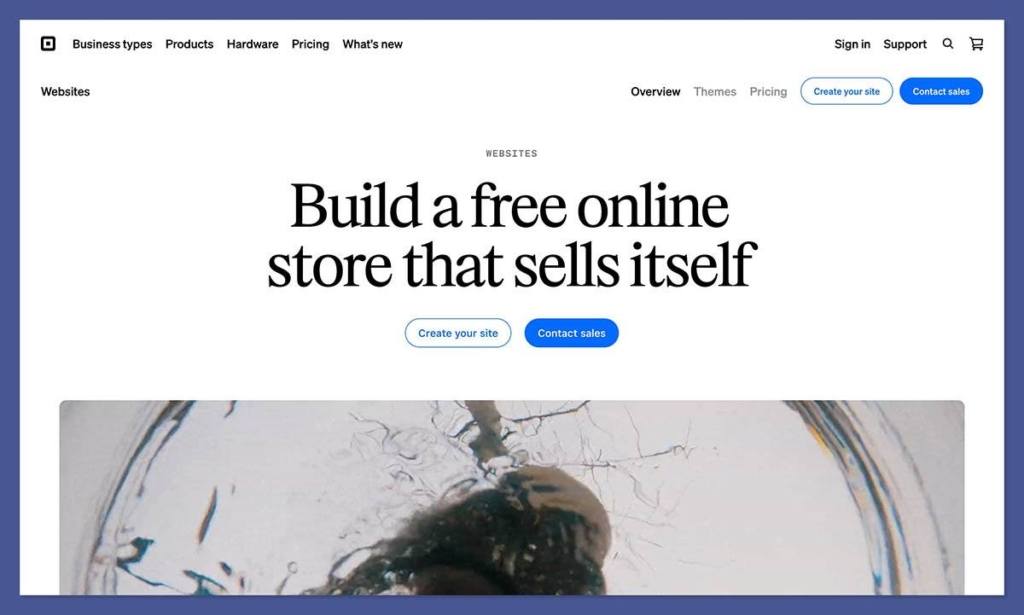
Square Online is the most direct free-tier competitor to Ecwid and probably the easiest switch if you’re a local business or you already use Square POS. The free plan has no product cap and no monthly fee, so you just pay 3.3% + 30¢ per online card sale on Free, dropping to 2.9% + 30¢ on the Plus plan.
What makes it genuinely different from Ecwid is the unified inventory between online and in-person. If you take card payments at a market, in a café, or at a pop-up, every Square reader sale updates the same product database your online store uses.
Ecwid offers POS through Lightspeed integrations, but Square Online has tighter native unification because it was built around Square’s payment hardware from the start.
The site builder is more limited than Shopify’s or Wix’s (fewer themes, less granular control over layout), but for a small local seller who needs a clean storefront and didn’t want to learn a new system, that simplicity is the point. Setup was the fastest of any platform I tested. I had a working store with three products live in under 20 minutes.
The catch is that Square Online really shines when you also use Square POS. If you don’t, you’re paying higher online card rates than Shopify Payments charges, and you lose the omnichannel inventory edge that’s the main reason to pick it over Ecwid.
Features
- Genuine free plan. Unlimited products, no monthly fee, only transaction fees per sale. Ecwid’s free plan caps you at 5 products.
- Unified Square POS. One inventory across online, in-person, invoices, and QR-code ordering. Tighter than Ecwid + Lightspeed POS for businesses already on Square hardware.
- 30-day free trial on paid plans. Plus ($49/mo) and Premium ($149/mo) both have a 30-day trial, which gives you time to test paid features before committing.
- Built-in marketing. Email and text campaigns, abandoned cart recovery on paid plans, and Google Business Profile integration. Comparable to Ecwid but more tightly bundled.
| Free Plan | Yes, with Square branding |
| Number of themes | 20+ |
| Product limit | Unlimited on free plan |
| Starting price | $0 (Free) / $49 (Plus) / $149 (Premium) |
3. Payhip: Best Ecwid Alternative for Digital Products and Creators
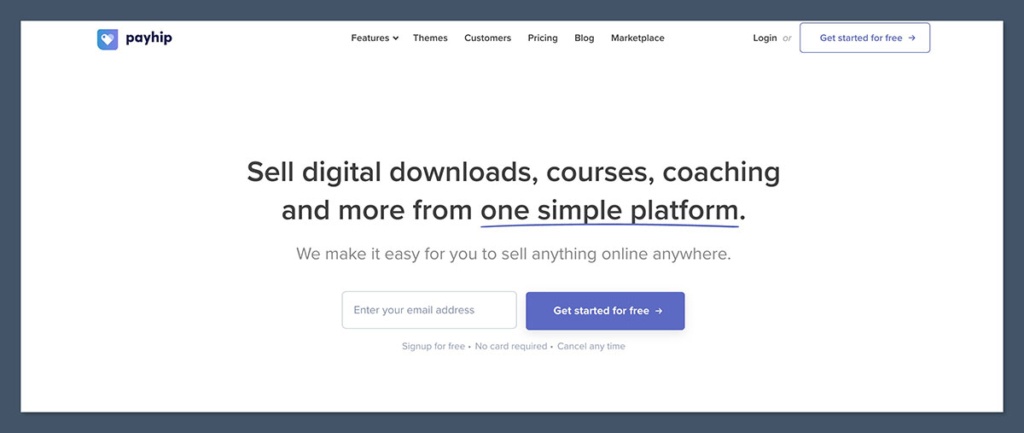
Payhip flips the pricing model that Ecwid uses. Instead of paying a monthly fee with no transaction cut, you can stay on Payhip’s free forever plan and pay 5% per sale, drop to 2% on the Plus plan ($29/mo), or kill the platform fee entirely on Pro ($99/mo). For creators who don’t want a fixed monthly cost, this is meaningfully better than Ecwid’s $5/mo Starter, especially since Payhip doesn’t gate features by plan.
Every Payhip plan includes the full feature set: digital products, courses, memberships, physical goods, EU and UK VAT collection, an affiliate system, coupons, and embeddable buy buttons.
With Ecwid, you have to climb plan tiers to unlock things like product variants, abandoned cart, or staff accounts. Payhip just gives you everything from day one and prices the per-sale fee instead.
The breakeven math is straightforward. Below about $970/month in revenue, the free plan beats Plus. Between $970 and $3,500/month, Plus saves you money. Above $3,500/month, Pro pays for itself. Compared to Ecwid, this means you can launch with zero monthly cost and only start paying when there’s revenue to justify it.
The trade-offs are real though. Payhip’s storefront customization is more basic than Ecwid’s, SEO controls are limited, and analytics are thinner than what you get even on Ecwid’s mid-tier plans. If you sell physical products at scale and care about brand, Payhip will start to feel cramped.
Features
- Free forever with full features. Every Payhip plan, including the free one, has unlimited products, unlimited revenue, and zero feature gating. Ecwid restricts features by plan.
- Native course and membership tools. Built-in course player, drip content, and membership tiers. Ecwid needs third-party apps for these.
- EU and UK VAT collection. Payhip calculates and collects EU/UK VAT on digital products automatically, though you still file. Ecwid handles this through tax apps.
- Embeddable checkout. Same as Ecwid: drop a buy button into any site, blog, or landing page. The closest like-for-like swap if you want Ecwid’s embeddable model with creator-focused features.
| Free Plan | Free forever (5% transaction fee) |
| Number of themes | Limited (single customizable storefront) |
| Product limit | Unlimited on all plans |
| Starting price | $0 (Free) / $29 (Plus) / $99 (Pro) |
4. BigCommerce: Best Ecwid Alternative for Larger Catalogs and B2B
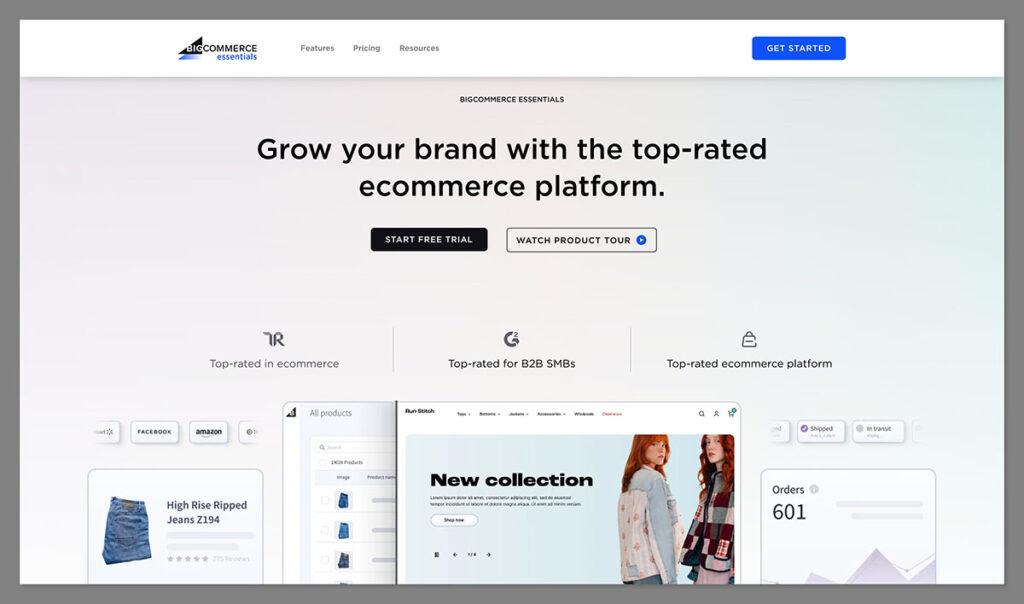
BigCommerce sits in the same price band as Shopify but tilts toward bigger catalogs and B2B sellers. Standard plan starts at $39/month ($29/month annual), the same as Shopify Basic, but BigCommerce includes things like real-time shipping quotes, product reviews, and faceted search natively. These usually mean adding paid apps on Shopify.
For Ecwid users with growing catalogs, the faceted search is the standout. Buyers can filter by size, brand, color, material, or any custom attribute, which Ecwid simply can’t do without third-party tools. If you sell more than a few hundred SKUs, this matters for conversion.
The B2B side is where BigCommerce pulls clearly ahead of Ecwid. Customer groups, price lists, quote management, and net payment terms are all available on the higher plans natively. Ecwid offers some wholesale features but nothing close to BigCommerce’s depth.
The catch is the revenue threshold model. Standard caps at $50k in trailing 12-month sales, then you’re auto-upgraded to Plus ($105/mo), then Pro ($399/mo) at $180k. The upgrades aren’t optional. For Ecwid users used to flat per-month pricing regardless of volume, this is something to plan around.
There’s also a 2026 pricing update rolling out from June 1 with renamed plans (Performance replaces Enterprise) and a new Open Payment Provider Fee on self-service plans, so check current numbers before you commit.
Features
- Native faceted search. Filter products by any attribute without third-party apps. Ecwid’s filtering is limited to category and price by default.
- B2B Edition tools. Customer groups, price lists, and bulk pricing on Plus and Pro plans, expanded on Enterprise/Performance. Ecwid doesn’t compete here.
- Multi-storefront management. Run multiple branded stores from one dashboard with shared or unique catalogs. Ecwid doesn’t have a native multi-storefront equivalent.
- Zero platform transaction fees. Like Ecwid, BigCommerce takes 0% on top of payment processing, though the new Open Payment Provider Fee from June 2026 will change this for some plans.
| Free Plan | 15-day free trial |
| Number of themes | 180+ (free and paid) |
| Product limit | Unlimited on all plans |
| Starting price | $39/mo Standard ($29/mo annual) |
5. Sellfy: Best Ecwid Alternative for Beginners Selling Digital + Physical

Sellfy is the platform I’d recommend to someone leaving Ecwid because they want one place that handles digital products, physical goods, subscriptions, and print-on-demand without stitching together apps. The Starter plan is $22/month annually (or $29 monthly), which is roughly comparable to Ecwid’s Business plan but with a far simpler feature gating model.
What stood out compared to Ecwid is built-in print-on-demand. Sellfy has its own POD integration, so you can design a t-shirt, mug, or hoodie inside the dashboard and sell it without setting up Printful or Printify separately. Ecwid does this through third-party apps, which works but adds setup steps and an extra tool to manage.
The interface is also more forgiving for beginners. You upload a product, set a price, connect Stripe or PayPal, and you’re selling. The whole thing took me less than 15 minutes to get the first product live, which is faster than every other platform on this list except Square Online.
Where Sellfy falls behind is design freedom. The storefront is functional but template options are thin, and there’s less SEO control than Ecwid’s Business plan offers.
The other thing to note is that Sellfy has annual revenue limits per plan ($10k on Starter, $50k on Business, $200k on Premium), and going over triggers a 2% overage fee or a forced upgrade. For most beginner sellers this is fine, but if you’re scaling fast it’s a wall to plan around.
Features
- Built-in print-on-demand. Native POD integration for t-shirts, mugs, posters, and accessories. Ecwid relies on Printful or Printify apps.
- Zero transaction fees on all plans. Same as Ecwid: only payment processor fees apply (Stripe, PayPal). No platform cut.
- Email marketing built in. Business and Premium plans include monthly email credits (10,000 and 50,000) so you can run campaigns without a separate Mailchimp account.
- Subscription products. Recurring billing on all plans, useful for memberships and subscription boxes. Ecwid supports subscriptions only from Business plan up.
| Free Plan | 14-day free trial |
| Number of themes | 15+ store designs |
| Product limit | Unlimited on all plans |
| Starting price | $22/mo Starter (annual) |
6. Squarespace: Best Ecwid Alternative for Design-Led Brands
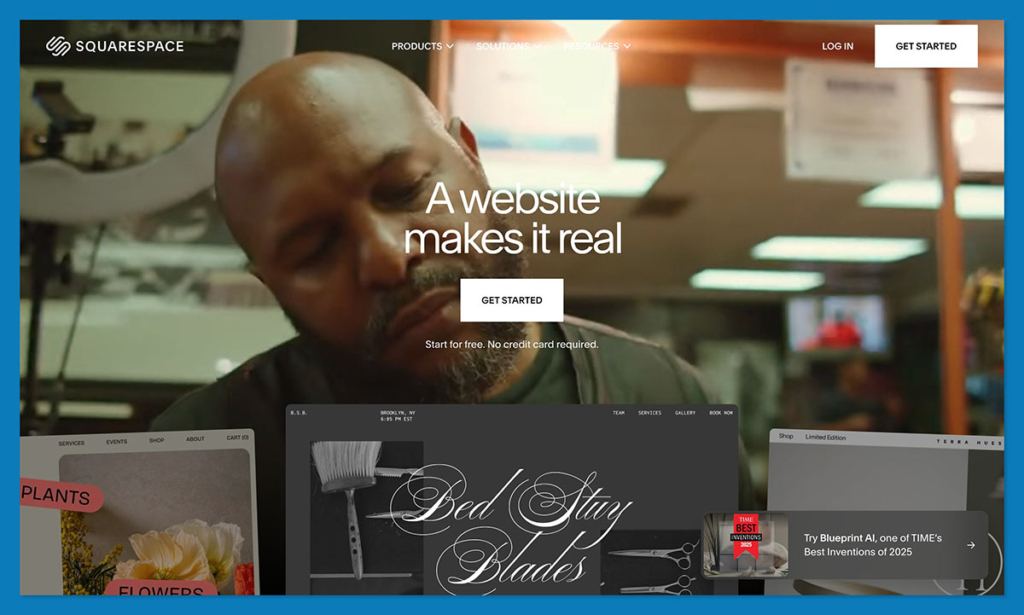
If you came to Ecwid because it lets you bolt a store onto an existing pretty site, Squarespace argues you shouldn’t have needed to do that in the first place. The templates are visibly more polished than Ecwid’s storefronts, and every plan now includes ecommerce, with even Basic at $16/month annually letting you sell unlimited products and subscriptions.
The new four-tier structure rolled out in late 2025 (Basic, Core, Plus, Advanced) replaced the old Personal/Business/Commerce setup. For most Ecwid users moving over, the Core plan at $23/month annually is the right starting point: it removes the 2% commerce transaction fee, adds analytics, and includes custom code access.
Where Squarespace genuinely beats Ecwid is the editor and templates. Squarespace’s Fluid Engine snaps blocks to a grid with consistent spacing, and the result looks designed rather than assembled. Ecwid’s storefront customization is mostly color and font tweaks on a pretty rigid layout.
For brand-conscious sellers (a small fashion label, a designer-maker studio, a creative service business), this is the difference between a site that feels yours and a site that feels like a template.
The downside is depth on the ecommerce side. Squarespace’s product catalog tools, shipping options, and B2B features are thinner than Shopify’s or BigCommerce’s. If you sell hundreds of SKUs with complex variants, you’ll feel the limits. There’s also a 1% digital products fee on the Plus plan and a 5% one on Basic and Core, which Ecwid doesn’t charge at all on its paid plans.
Features
- Top-tier templates. The most visually polished templates of any platform on this list. Worth the upgrade from Ecwid alone if design matters to your brand.
- Mid-build template switching. Switch templates without rebuilding your site. Ecwid lets you change themes too, but with less stylistic range.
- Squarespace Payments. Built-in payment processing with Klarna, Afterpay, Apple Pay, and ACH support across the US, UK, EU, and Canada.
- Native Acuity Scheduling. If you sell services or appointments alongside products, the integrated booking system is more capable than Ecwid’s appointment app options.
| Free Plan | 14-day free trial |
| Number of themes | 195+ |
| Product limit | Unlimited on all plans |
| Starting price | $16/mo Basic (annual) |
Other Notable Ecwid Alternatives
7. Wix eCommerce
Wix eCommerce is the option for Ecwid users who want a full website builder with a store baked in, and who care more about drag-and-drop design freedom than ecommerce depth. The drag-and-drop editor is more flexible than Squarespace’s, and the App Market has over 250 ecommerce-related apps including Printful, fulfillment, and shipping integrations.
Where Wix beats Ecwid is the storefront freedom. You can build any layout you want, mix content and product pages, and add unrelated functionality (booking, restaurants, blogs) without a separate platform. Where it falls short is checkout polish and ecommerce depth. Shopify’s and BigCommerce’s stores feel more purpose-built. Wix’s ecommerce starts at the Core plan, around $29/month, which is more than Ecwid’s Venture but gets you a full website along with the store.
8. WooCommerce
If you’re an Ecwid user already on WordPress, WooCommerce is the obvious move once you outgrow the embeddable widget. The plugin itself is free, you have access to thousands of extensions, and you can shape the store to do almost anything. There are no platform fees and no product limits.
The trade-off is everything you don’t see. You’ll need hosting (decent managed WP hosting starts around $15 to $30/month for small stores), an SSL certificate, and a security/backup setup. Many key features come from paid extensions ($30 to $200 each), and you’re responsible for updates. Total cost of ownership often beats Ecwid’s at higher revenue levels but is harder to predict at the start. Best for technical users or those willing to hire a developer.
9. PrestaShop
PrestaShop is the open-source alternative for Ecwid users who want maximum control over their store and have the technical chops (or the budget) to manage it. Over 300,000 brands use it, with strong multilingual and multi-currency support out of the box, which beats Ecwid’s translation handling for genuinely international stores.
The core software is free, but you’ll pay for hosting, themes (typically $50 to $300), and modules (often $30 to $200 each). PrestaShop’s strength is customization depth: you can change almost anything about the storefront and checkout, but that comes with the same maintenance overhead as WooCommerce. Best for technical merchants and agencies, not for the kind of “set up over a weekend” sellers Ecwid traditionally serves.
10. Shift4Shop
Shift4Shop is worth knowing about because of its end-to-end ecommerce plan, which is free in the US if you process payments through Shift4 Payments and meet a minimum monthly volume. For US sellers willing to commit to one payment processor, this is one of the few genuinely free routes into a full ecommerce platform, with no product caps and no plan-gated features.
It includes built-in features that Ecwid usually requires apps for: product reviews, gift certificates, real-time shipping, and a decent template library. The catches are that the editor is dated compared to Shopify or Squarespace, the free plan only works for US merchants, and you’re locked into Shift4 Payments processing rates. If those aren’t dealbreakers, the price-to-feature ratio is hard to beat.
Find the Best Ecwid Alternative for Your Needs
Ecwid does the embeddable cart job genuinely well, but it’s not the right home for every store. After testing the alternatives, here’s how I’d narrow it down based on what you’re actually trying to fix.
If you’ve outgrown Ecwid’s product limits and design constraints and want a real ecommerce platform with the biggest app ecosystem, Shopify is the obvious move. The price is higher but the conversion lift from Shop Pay and the time saved on app sprawl usually pays for itself.
If you run a local business with in-person sales and want one inventory across online and POS, Square Online beats almost everything else.
The free plan removes Ecwid’s product cap entirely, and the Square POS integration is tighter than Ecwid’s Lightspeed setup for shops already using Square hardware.
If you mainly sell digital products, courses, or memberships and don’t want a fixed monthly fee, Payhip is the best switch. The free forever plan with full features and the 5% revenue share model fits creator businesses better than Ecwid’s plan tiers.
FAQ
Can I migrate my Ecwid store to another platform?
Yes. Most major platforms (Shopify, BigCommerce, Squarespace, WooCommerce) have either built-in import tools or third-party migration services that move products, customers, and order history from Ecwid. Shopify has the smoothest path through its Store Importer app. For more complex migrations or larger catalogs, services like LitExtension or Cart2Cart handle the move for a one-time fee.
Which Ecwid alternative is the cheapest long-term?
For low-volume sellers, Payhip’s free forever plan is the cheapest option since you only pay 5% per sale with no monthly fee. Square Online’s free plan is comparable for physical product sellers. For mid-volume stores, Sellfy’s $22/month Starter plan with 0% transaction fees often works out cheaper than Ecwid’s Business plan once you factor in feature parity.
Which Ecwid alternative has the lowest fees?
BigCommerce, Ecwid, Sellfy, and Shopify (with Shopify Payments) all charge 0% platform transaction fees, so the only cost is the payment processor’s cut (typically 2.9% + 30¢). Payhip’s Pro plan also hits 0% but costs $99/month. Square Online’s free plan charges higher per-sale rates (3.3% + 30¢ online), which can be more expensive than a paid plan with a lower percentage.
Is Ecwid still worth using in 2026?
Ecwid is still a solid choice if your main need is adding ecommerce to an existing website without rebuilding it, especially after the rebrand to Lightspeed expanded its POS integrations. But if you’ve hit the Starter plan’s 10-product cap, want a real standalone storefront, or need a deeper app ecosystem, an alternative will almost always serve you better. The March 2026 price changes also pushed Ecwid out of its previous “cheapest serious option” position.
How hard is it to switch from Ecwid?
Easier than most people expect. Product imports and customer data migration are well-documented for every major alternative. The harder parts are usually rebuilding integrations (email tools, shipping apps, third-party plugins) and getting the new storefront design where you want it. Most merchants can complete a switch over a weekend; complex stores with custom integrations or large catalogs may need a week or two and possibly a developer.