Shopify and HubSpot are two of the biggest names in online business software, but they solve very different problems.
Shopify is built to sell products, while HubSpot is built to manage customers. We’ve researched and tested both platforms in depth to help you understand which one your business actually needs, and when it makes sense to run them together.
The short answer: if your goal is to launch and grow an online store, Shopify is the clear choice. If your goal is to manage leads, automate marketing, and track customers through a sales pipeline, HubSpot wins. Many growing ecommerce brands eventually use both.
Shopify vs HubSpot: Quick Verdict
- Shopify: Best for selling online, ideal for building and scaling an ecommerce store
- HubSpot: Best for CRM, marketing automation, and managing the customer lifecycle
In this comparison, I’ll look at how Shopify and HubSpot stack up on pricing, sales features, marketing tools, ease of use, and integrations, so you can decide which platform deserves your budget (or whether the smartest move is combining the two).
Quick Comparison: Shopify vs HubSpot
Get a quick and clear overview of Shopify and HubSpot in the table below:
| Shopify | HubSpot | |
|---|---|---|
| What it is | Ecommerce platform for building and running online stores | Customer platform centered on CRM, marketing, sales, and service |
| Entry price | $29/month (billed annually) or $39/month (billed monthly) | Free CRM; Starter from $15 per seat/month (billed annually) |
| Mid-tier price | Grow: $79/month annually ($105 monthly) | Marketing Hub Professional: from $890/month (includes 3 seats), plus a $3,000 one-time onboarding fee |
| High-end price | Advanced: $299/month annually ($399 monthly); Plus from $2,300/month | Marketing Hub Enterprise: from $3,600/month (includes 5 seats) |
| Free option | 3-day free trial, then first 3 months for $1/month | Free CRM with basic tools for up to 5 core seats |
| Best for | Selling products online, in person, and across marketplaces | Lead generation, email automation, pipeline tracking, and reporting |
| Checkout and payments | Built in, with Shopify Payments and 100+ gateways | Basic payment links and quotes only; not built for storefronts |
| CRM | Basic customer profiles and segmentation | Full CRM with deals, pipelines, and lifecycle stages |
Key Takeaways
- Shopify and HubSpot are not direct substitutes. Shopify is a commerce engine for transactions; HubSpot is a growth engine for relationships.
- Shopify wins for selling online. Storefronts, checkout, inventory, shipping, taxes, POS, and marketplace selling are all built in.
- HubSpot wins for marketing and CRM. Its automation, lead nurturing, and reporting go far beyond anything Shopify offers natively.
- HubSpot gets expensive faster. Seat-based and credit-based pricing means costs climb quickly as your team and contact list grow.
- The two integrate well. HubSpot’s Shopify data sync lets ecommerce brands run their store on Shopify and their lifecycle marketing in HubSpot.
1. Best for Pricing: Shopify

If you’re comparing entry costs, Shopify is the more predictable and affordable platform for an ecommerce business. Its three core plans range from $29 to $299 per month when billed annually, and the introductory deal gives you your first three months for $1/month.
Take a look at Shopify’s plans below:
- Basic: $29/month annually ($39 billed monthly), 2.9% + 30¢ per online card transaction; a full store with unlimited products, abandoned cart recovery, and up to 2 staff accounts
- Grow: $79/month annually ($105 billed monthly), with lower card rates; adds standard reports, advanced inventory tools, and up to 5 staff accounts
- Advanced: $299/month annually ($399 billed monthly), with the lowest card rates; adds custom reporting and up to 15 staff accounts for scaling stores
- Plus: from $2,300/month for enterprise brands that need custom checkout, B2B features, and dedicated support
HubSpot’s pricing works completely differently, and this is where buyers get caught out. There’s a genuinely useful free CRM, and Starter plans begin at just $15 per seat per month (billed annually).
But the jump to Professional is steep: Marketing Hub Professional starts at $890/month with 3 seats included, plus a one-time onboarding fee of $3,000. Enterprise starts at $3,600/month.
On top of that, HubSpot bills different Hubs (Marketing, Sales, Service, Content) separately, charges for extra seats, and prices marketing contacts in tiers. A growing team can see its HubSpot bill double or triple within a year without changing plans, simply by adding people and contacts.
Shopify has its own hidden costs too: payment processing, premium themes, and paid apps all add up. But the core subscription is a flat, predictable monthly fee, which makes budgeting far simpler.
The Winner: Shopify’s pricing is simpler and cheaper for ecommerce businesses
Shopify’s flat plans from $29 to $299 per month are easy to budget for. HubSpot starts free but its seat-based, modular pricing can escalate quickly, especially once you need Professional features.
2. Best for Selling Online: Shopify
This category isn’t close. Shopify is an ecommerce platform first and foremost, with everything you need to sell built directly into every plan: storefront design, product and inventory management, checkout, shipping, tax calculation, B2B catalogs, point of sale, and marketplace selling.
Shopify’s checkout is a particular strength. The company markets it as the world’s best converting checkout, and while that’s marketing speak, the underlying point stands: it’s fast, mobile-optimized, and supports Shop Pay, Apple Pay, Google Pay, PayPal, and over 100 other payment methods. Shopify Payments, the native gateway, charges 2.9% + 30¢ per online transaction on the Basic plan, dropping to 2.5% + 30¢ on Advanced.
Shopify has also pushed hard into AI-assisted commerce. Sidekick, its built-in AI assistant, helps with everything from writing product descriptions to analyzing store performance, and Shopify Flow automates back-office tasks like inventory alerts and order tagging.
HubSpot, by contrast, was never designed to run a store. Its Commerce Hub lets you create payment links, quotes, and invoices, which works fine for service businesses and B2B deals. But there’s no real storefront builder, no inventory system, no shipping integration, and no POS. If you tried to run a product business on HubSpot alone, you’d hit a wall within a week.
The Winner: Shopify is built to sell, HubSpot isn’t
Shopify gives you a complete commerce stack out of the box: storefront, checkout, payments, inventory, shipping, and POS. HubSpot’s commerce tools stop at payment links and invoices.
3. Best for Marketing and CRM: HubSpot
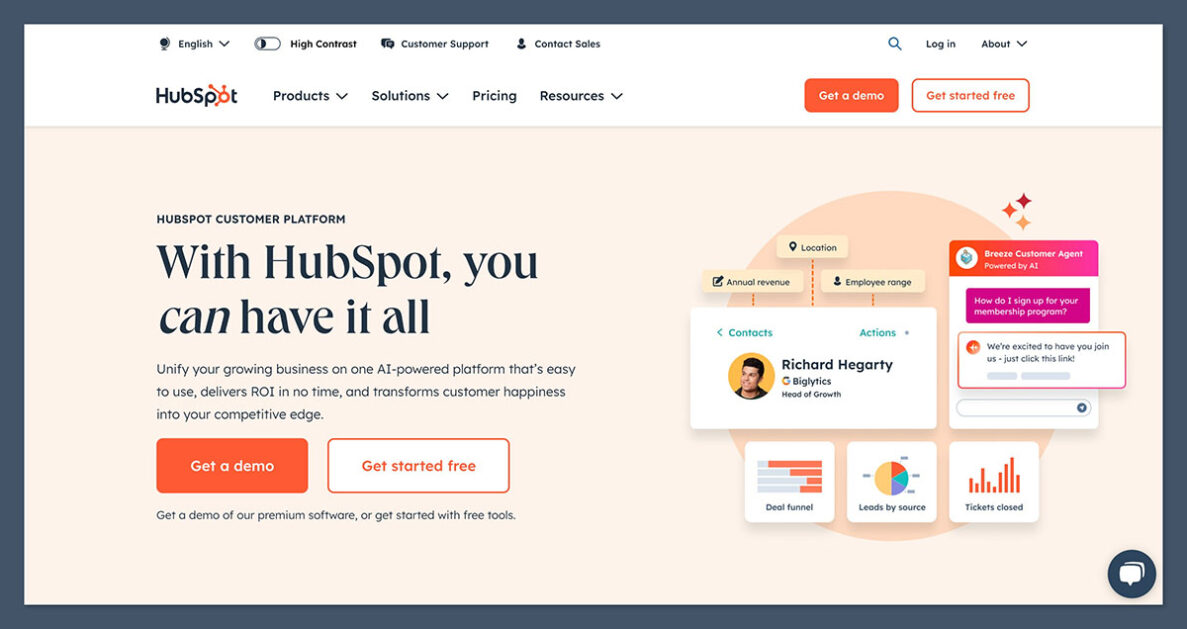
Flip the question around, though, and HubSpot dominates just as clearly. If your priority is generating leads, nurturing them with automated campaigns, and tracking every customer interaction in one place, HubSpot is one of the best platforms on the market.
HubSpot’s Marketing Hub covers email marketing, landing pages, forms, social media management, ad tracking, and SEO recommendations. Its automation workflows are genuinely powerful: you can build multi-step journeys triggered by almost any customer behavior, from a page visit to an abandoned form.
Reporting spans the full customer lifecycle, so you can see which campaigns actually produce revenue, not just clicks.
The CRM underneath it all is the real differentiator. Every contact, deal, email, and support ticket lives in a single record, and HubSpot’s AI tools (branded Breeze) add features like an AI customer support agent and content assistance. The platform also connects to over 2,000 apps through its marketplace.
Shopify’s marketing tools are respectable for a commerce platform. Shopify Email lets you build campaigns from your admin, customer segmentation is solid, and integrations with TikTok, Instagram, and Google make multichannel promotion straightforward.
But its CRM capabilities are thin: customer profiles and segments, not pipelines, lifecycle stages, or lead scoring. Most serious Shopify brands end up bolting on a dedicated email/SMS platform or a CRM anyway.
The Winner: HubSpot’s marketing automation and CRM are in a different league
HubSpot offers full-funnel automation, lead scoring, lifecycle reporting, and a true CRM. Shopify’s built-in marketing tools cover the basics but were never meant to manage relationships at depth.
4. Easiest to Use: Shopify
Both platforms are polished, but they ask very different things of you.
Shopify’s onboarding is famously quick. You answer a few questions about your business, and within minutes you’re adding products and customizing a theme with its section-based editor. The setup checklist walks you through every step from products to payments to launch.
The editor isn’t a true drag-and-drop builder, which can feel restrictive, but for getting a store live fast, it’s hard to beat.
HubSpot’s free CRM is also easy to start with, and credit where it’s due: the interface is clean and the free tools are generous.
The complexity arrives as you scale. Understanding the difference between core seats and paid seats, which features live in which Hub, how marketing contacts are billed, and how workflows interact takes real time. Professional-tier accounts typically require paid onboarding, and many companies hire HubSpot partner agencies just to set the platform up properly.
That’s not a flaw exactly, it reflects how much HubSpot does. But if you’re a small team that wants to start selling this week, Shopify’s learning curve is far gentler.
The Winner: Shopify gets you from signup to selling faster
Shopify’s guided setup and section-based editor make launching simple. HubSpot’s free tier is approachable, but its full platform takes significant time (and often paid onboarding) to master.
5. Best Together: The Shopify + HubSpot Integration
Here’s the section most comparison articles skip: for many ecommerce brands, the right answer isn’t Shopify or HubSpot, it’s Shopify and HubSpot.
HubSpot’s official Shopify Data Sync integration pulls your store data into the CRM. Contacts and products sync bidirectionally, while orders and abandoned checkouts sync one-way from Shopify into HubSpot. That gives your marketing team the ability to segment customers by purchase history, trigger win-back campaigns, recover abandoned carts with personalized emails, and report on revenue by campaign.
One important update to be aware of: HubSpot has restructured how the integration handles orders. Shopify orders no longer sync to HubSpot Deals and instead sync to a dedicated Order object, and existing users have been asked to reinstall the integration.
If you’ve built automation or reporting on top of Deals, you’ll need to rework it around the new Order object, so factor that migration into your planning.
The practical setup many growing brands land on looks like this: Shopify runs the storefront, checkout, and fulfillment; HubSpot runs the CRM, lifecycle marketing, and service desk; and some teams add a dedicated ecommerce email/SMS tool if they need deeper revenue automation than HubSpot provides.
The Winner: It’s a tie, because this is where both platforms shine
The Shopify + HubSpot combination beats either platform alone for brands that need serious commerce and serious CRM. Just plan around the new Order object sync model.
How We Compare Ecommerce and Marketing Platforms
We evaluate platforms across weighted criteria based on what matters most to businesses choosing software for growth:
| Criteria | Weight | What we assess |
|---|---|---|
| Core features | 40% | How well the platform delivers on its primary job: commerce for Shopify, CRM and marketing for HubSpot |
| Pricing and value | 20% | Entry cost, total cost of ownership, and how predictably pricing scales |
| Ease of use | 15% | Onboarding speed, interface clarity, and learning curve |
| Integrations | 15% | App ecosystem quality and how well the platform connects to other tools |
| Help and support | 10% | Support channels, documentation, and community resources |
Shopify vs HubSpot: Our Winner
For businesses whose primary goal is selling products online, Shopify is the winner. It delivers a complete, reliable commerce stack at a predictable price, and nothing in HubSpot’s toolkit replaces a real storefront, checkout, and fulfillment system.
But framing this as a head-to-head undersells what HubSpot is. If your business runs on leads, pipelines, and long customer relationships, HubSpot is the stronger platform, and Shopify can’t match its automation or reporting depth.
The honest verdict: Shopify wins on commerce execution, HubSpot wins on customer lifecycle management, and the best choice depends on whether your business is optimizing for transactions or relationships. If you’re an ecommerce brand with real growth ambitions, the strongest setup is often both, connected through HubSpot’s Shopify integration.
Frequently Asked Questions
Can HubSpot replace Shopify?
No. HubSpot’s Commerce Hub handles payment links, quotes, and invoices, which suits service and B2B businesses, but it has no storefront builder, inventory management, shipping tools, or point of sale. If you sell physical or digital products at any volume, you need a dedicated ecommerce platform like Shopify.
Can Shopify replace HubSpot?
Only for very simple needs. Shopify includes basic customer profiles, segmentation, and email campaigns, which may be enough for a small store. It does not offer lead scoring, sales pipelines, multi-step automation workflows, or lifecycle reporting. Businesses that rely on nurturing leads over time will outgrow Shopify’s built-in tools quickly.
Is HubSpot more expensive than Shopify?
At the entry level, no: HubSpot’s CRM is free and Starter plans cost $15 per seat per month, while Shopify starts at $29/month billed annually. At scale, HubSpot usually becomes the more expensive platform. Marketing Hub Professional starts at $890/month plus a $3,000 onboarding fee, and costs grow with every added seat, Hub, and batch of marketing contacts. Shopify’s costs grow more gradually through apps and payment processing.
Do Shopify and HubSpot integrate?
Yes. HubSpot’s official Shopify Data Sync integration syncs contacts and products bidirectionally and pushes orders and abandoned checkouts from Shopify into HubSpot. Note that orders now sync to a dedicated Order object in HubSpot rather than to Deals, so any automation built on Deal-based order data needs to be updated.
Which is better for a small business just starting out?
It depends on what you’re starting. If you’re launching a product business, start with Shopify: you can have a working store within a day. If you’re launching a service or B2B business that lives on leads and follow-ups, start with HubSpot’s free CRM and upgrade only when you hit its limits.
Should an ecommerce brand use both platforms?
Many growing brands do. A common setup is Shopify for the storefront, checkout, and fulfillment, with HubSpot handling CRM, email automation, and customer service. The combination gives you native commerce and full lifecycle marketing without forcing either platform to do a job it wasn’t built for.