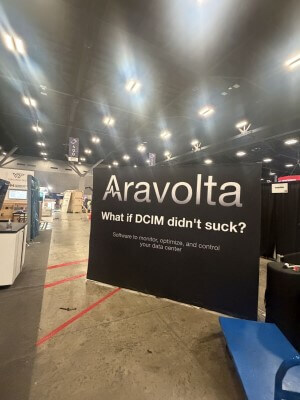
Aravolta has secured $5.1 million to enhance its next-generation data center operations platform tailored for the AI era, addressing the complexity of GPU-dense infrastructure. This funding underscores the increasing investor interest in software that manages the interconnected power, cooling, and networking systems essential for modern AI workloads.
The company integrates data center infrastructure management (DCIM), electrical power monitoring systems (EPMS), and building management systems (BMS) into a unified control layer. While DCIM is common in large facilities, Aravolta contends that legacy tools are inadequate for the dynamic demands of AI-focused data centers, where minor configuration changes can have significant impacts.
Aravolta is led by CEO Margarita Groisman, CTO Jack Sutton, and COO Pietro Sette. Groisman has experience with large-scale chip and server deployments at Microsoft, Sutton has been a founding engineer at multiple startups, and Sette has led engineering and operations at high-growth software companies. The team is committed to automating and optimizing physical systems for compute-intensive workloads.
Groisman notes that new data center operators are realizing AI-supportive facilities differ from traditional environments. GPU clusters impose extreme and variable power and cooling demands, with more interdependent infrastructure components. Operators require real-time visibility and automated decision-making rather than static reporting.
Aravolta’s platform collects telemetry from branch circuit monitoring, precision power metering, and environmental systems, transforming it into operational workflows and controls. The company aims to enable decisions and automated responses, applying data-driven operational intelligence to physical infrastructure.
Early customers include colocation providers, chip manufacturers, edge data center operators, and emerging “neocloud” platforms focused on AI workloads. Named users include OpenColo, Flexnode, DataCrunch, and Centra, with others undisclosed. These organizations typically operate smaller, specialized facilities where efficiency and reliability are crucial.
The $5.1 million funding round involves venture firms like Topology, Wishchoff, Crucible, Susa, Afore, and Banyan, plus Y Combinator and the Pioneer Fund. Notable angel investors such as Guillermo Rauch and Nick Hansen also participated, indicating interest from those knowledgeable about scaling complex technical systems.
While Aravolta competes in the DCIM category, its focus on automation and control reflects a broader industry shift. As AI drives rapid compute infrastructure expansion, operators must deploy capacity swiftly while ensuring reliability, energy efficiency, and safety. Software platforms that reduce operational friction and offer a unified facility view are becoming essential.
With AI infrastructure investments rising globally, Aravolta anticipates the next phase of data center innovation will be defined more by software orchestration than hardware alone.
Executive Insights FAQ
Why are AI-era data centers harder to operate than traditional facilities?
GPU-heavy environments demand highly variable power and cooling, with tightly coupled systems where small changes affect overall stability.
What problem is Aravolta trying to solve for operators?
The company aims to unify fragmented operational data into real-time decisions and automated controls rather than static monitoring.
How is Aravolta different from traditional DCIM platforms?
Its platform integrates DCIM, EPMS, and BMS data into a single control layer designed for dynamic, high-density AI workloads.
Who is adopting this type of software today?
Early adopters include colocation providers, neoclouds, chip manufacturers, and edge data center operators focused on AI infrastructure.
Why are investors backing this category now?
The rapid growth of AI infrastructure has revealed operational gaps that legacy tools cannot address, creating demand for more intelligent control software.