After spending weeks testing both Tapstitch and Printify across multiple product categories, store integrations, and sample orders, I can say these two platforms are solving fundamentally different problems. Tapstitch is the POD service you pick when you’re building a fashion brand. Printify is what you pick when you’re building a business.
That’s not a knock on either. It’s just how they’re wired. Tapstitch controls its own production, uses its own heavyweight blanks, and caters almost exclusively to apparel sellers who care deeply about fabric weight, garment fit, and the kind of unboxing experience that makes customers come back. Printify connects you to around 90 print providers worldwide, gives you 1,300+ products across every category imaginable, and lets you optimize for price, region, and turnaround on a per-product basis.
So the real question isn’t which platform is “better.” It’s which one fits the kind of store you’re actually building.
⚡ Quick Verdict
Tapstitch wins on garment quality, blank selection, and brand feel. If you’re launching a streetwear label or curated apparel line and your customers pay $35–50 per tee, this is your platform.
Printify wins on catalog size, pricing flexibility, multi-channel reach, and profitability at scale. If you want variety, lower base costs, and the tools to grow fast across multiple sales channels, Printify is the stronger pick.
🔍 Key Takeaways
- Tapstitch is a vertically integrated, fashion-first POD platform that owns its production and blanks. Printify is a marketplace connecting sellers to 90+ independent print providers globally.
- Tapstitch’s heavyweight tees, premium hoodies, and fashion-forward silhouettes feel retail-grade, but the catalog is apparel-only and limited compared to Printify’s 1,300+ products.
- Printify’s comparison data suggests over 60% higher monthly profits versus Tapstitch at similar sales volumes, thanks to lower base costs and Premium plan discounts.
- Tapstitch supports Shopify, Etsy, and Wix. Printify integrates with Shopify, Etsy, eBay, Walmart, TikTok Shop, WooCommerce, and offers a custom API.
- Tapstitch’s custom neck labels and branded shipping feel polished for apparel brands, but hang tags and branded packaging are still in development.
- Printify’s quality is provider-dependent but optimizable, its scoring system and Quality Promise help you find top performers, and you can switch providers anytime.
Quick Comparison
| Feature | Tapstitch | Printify |
|---|---|---|
| Core focus | Fashion-first apparel POD | Multi-category POD marketplace |
| Business model | In-house production, own blanks | Aggregator with ~90 print providers |
| Monthly fee | Free (pay-per-order) | Free / Premium $24.99/mo / Enterprise |
| Product catalog | Apparel-focused (tees, hoodies, joggers) | 1,300+ across apparel, home, accessories |
| Print methods | DTG and DTF (Kornit, Brother) | DTG, sublimation, embroidery, DTF (varies) |
| Key integrations | Shopify, Etsy, Wix | Shopify, Etsy, eBay, Walmart, TikTok, API |
| Branding | Custom neck labels, branded shipping | Provider-dependent (varies) |
| Trustpilot | ~4.3/5 | ~4.6/5 |
| Best for | Streetwear brands, curated fashion | Multi-product sellers, high-volume ops |
What Kinds of Businesses Is Tapstitch or Printify Best For?
Have a specific business model in mind? Here’s a quick breakdown of who each platform actually serves best:
Tapstitch Is Best For…
- Streetwear and fashion-forward brands that want heavyweight blanks (6.5 oz+ tees, 400 GSM hoodies) and modern silhouettes like oversized fits
- Curated, small-catalog sellers running limited drops or capsule collections, you need 15 products that feel premium, not 1,000 SKUs
- Brand builders who want custom neck labels, retail-grade unboxing, and products that don’t scream “generic POD”
Printify Is Best For…
- Multi-channel operators selling across Shopify, Etsy, eBay, Walmart, and TikTok Shop who need wide integration support
- High-volume, margin-focused sellers who prioritize lower costs and the ability to optimize per product for price, quality, and speed
- Diversified product sellers who want to go beyond apparel into home decor, accessories, drinkware, and more from one platform
1. Pricing and Profitability 💰
Both platforms are free to start, no subscription needed to get going. But the way costs stack up once you’re actually selling is where they pull apart.
Tapstitch Pricing
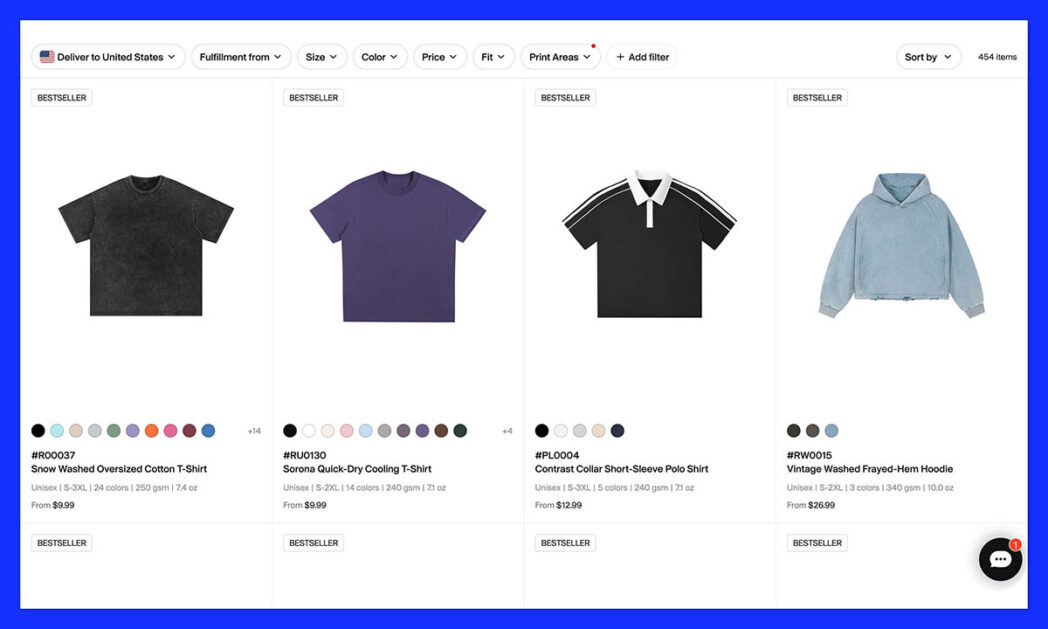
Tapstitch runs a pay-per-order model. You pay for the blank, printing, and shipping on each order. No mandatory monthly fee. Here’s what a typical heavyweight tee order looks like:
| Cost Component | Amount (USD) |
|---|---|
| Heavyweight blank T-shirt | $10.95 |
| One-side DTG print | $5.00 |
| Custom neck label | $1.50 |
| US shipping (first item) | $5.50 |
| Total cost per unit | $22.95 |
At a $40 retail price, that leaves about $17.05 in gross profit per shirt. Healthy margin if you’re pricing at the premium end, which is exactly where Tapstitch expects you to be. The shipping structure also supports bundling: additional items in the same order cost around $2.00 each, making multi-item carts more profitable.
Printify Pricing
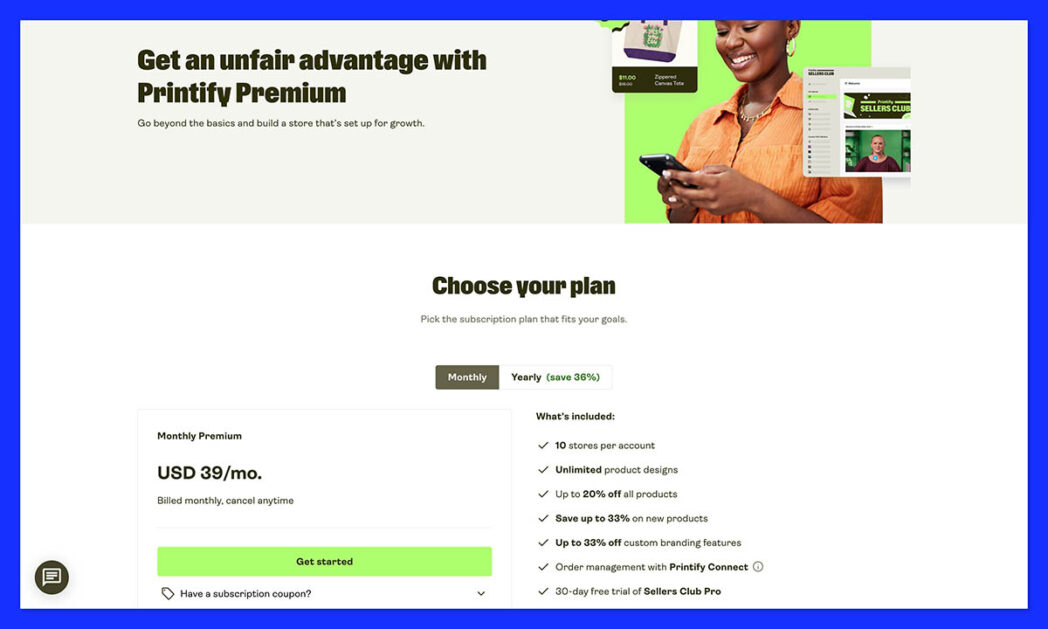
Printify keeps its Free plan genuinely free, you pay product costs and shipping only when an order comes in. The Premium plan runs about $24.99 per month and unlocks up to 20% off product costs, which compounds fast at scale. There’s also an Enterprise tier with custom pricing for high-volume brands.
Where it gets interesting: independent profitability comparisons from early 2026 show Printify generates substantially higher monthly profits than Tapstitch at both low and high sales volumes. The same analysis claims over 60% higher monthly profits with Printify when using Premium plan discounts. Lower base costs on products and shipping just add up, especially once you’re doing consistent volume.
Author’s Note 📝
The profit gap isn’t surprising when you think about it. Tapstitch’s blanks are genuinely premium, heavyweight fabrics, fashion-forward fits, better hand-feel. That costs more to produce. You’re paying for quality that justifies higher retail prices ($35–50 per tee). With Printify, you’re optimizing for margin, not material weight. Neither approach is wrong. It depends entirely on what your brand promises to the customer.
🏆 Winner
Printify wins on pure profitability. Lower base costs, a free tier that doesn’t limit features, and a Premium plan that compounds savings at scale. Tapstitch can still generate strong per-unit margins, but only if your pricing strategy supports premium positioning.
2. Product Catalog and Selection
This is where the two platforms couldn’t be more different, and it’s probably the fastest way to figure out which one you need.
Tapstitch’s Catalog
Tapstitch is intentionally narrow and deep in apparel. The catalog focuses on heavyweight cotton tees (often 6.5 oz and up), premium hoodies with around 400 GSM fleece, joggers, long sleeves, crewnecks, and limited outerwear. These are garments designed with streetwear aesthetics in mind, slightly oversized fits, clean silhouettes, the kind of cuts you’d expect from a mid-tier fashion brand.
Non-apparel options like mugs, home goods, and phone cases? Either limited or not a focus. If you want to sell posters alongside your tees, Tapstitch isn’t built for that.
Printify’s Catalog
Printify takes the opposite approach: 1,300+ products across apparel (tees, hoodies, leggings, swimwear), home decor (posters, canvas, blankets, pillows), drinkware (mugs, tumblers, water bottles), and accessories (phone cases, bags, hats, stickers). The breadth is massive, and it lets you test niches quickly, create product bundles, and expand into new categories without switching platforms.
Top Tip 💡
If you’re building a fashion brand with a tight, curated collection, say 10 to 20 products, Tapstitch’s focused catalog is actually an advantage. It forces you to be intentional about your line. But if you’re an Etsy seller who wants to test seasonal designs across mugs, tees, and tote bags all at once, Printify’s breadth is hard to beat.
🏆 Winner
Printify wins on catalog size and diversity by a wide margin. Tapstitch wins if you only care about premium apparel and don’t need anything else, but for sheer selection, it’s not close.
3. Print Quality and Consistency
This is where Tapstitch punches above its weight and genuinely earns its premium positioning.
Tapstitch Quality
Because Tapstitch controls its own production, running Kornit and Brother DTG machines alongside DTF printing, there’s a noticeable consistency across orders. The heavyweight tees and 400 GSM hoodies feel substantial in hand. Fits lean toward slight oversize and fashion-forward silhouettes. Color reproduction is sharp when files are prepped properly.
User reviews on the Shopify App Store (4.7 stars across 80+ reviews) and Trustpilot consistently call out the “retail-quality” feel. Reviewers praise the fabric weight, print vibrancy, and the fact that garments look like something you’d buy in a boutique, not a typical POD product. The most common complaints? Occasional color vibrancy inconsistencies on certain colorways, sizing chart mismatches, and slower shipping outside the US.
Printify Quality
Printify’s quality story is more nuanced because it depends entirely on which print provider you choose. The platform promotes a “Quality Promise” and uses a data-driven scoring system to rank providers based on performance and customer feedback. Useful, but it means you need to actively manage your provider selection, test samples, and be ready to switch if a provider drops off.
The upside is flexibility. You can choose providers that specialize in specific print methods (DTG, sublimation, embroidery) and pick the one that delivers the best results for each product type. The downside: quality isn’t plug-and-play. It takes effort to dial in.
Author’s Note 📝
Honest take, if you hand someone a Tapstitch heavyweight tee and a standard Printify tee side by side, the Tapstitch one feels noticeably better. The fabric weight, the cut, the overall hand-feel, it’s a different product category. But that comparison isn’t entirely fair. Printify gives you the freedom to source from premium providers too. You just have to find them and test them yourself, which takes more time.
🏆 Winner
Tapstitch wins on out-of-the-box apparel quality. The blanks are consistently premium, prints are sharp, and the overall product feels retail-grade without any provider management on your end. Printify can match it, but you’ll need to put in the work to find and vet the right providers.
4. Branding and Customization
If you’re building a brand, not just selling printed products, the branding features a POD platform offers can make or break the customer experience.
Tapstitch Branding
Tapstitch invests heavily in apparel-specific branding. The standout feature is custom printed neck labels, which dramatically improve perceived quality versus the generic tags you get with most POD services. Customers notice these details. It’s the kind of thing that separates “I bought a printed tee online” from “I bought from a clothing brand.”
Beyond neck labels, Tapstitch supports front and back prints, sleeve prints, multiple size and color options, transparent background mockups, and branded shipping addresses. Hang tags and branded packaging are still in development as of early 2026, on the roadmap but not fully rolled out.
| Branding Feature | Tapstitch | Printify |
|---|---|---|
| Custom neck labels | Available | Provider-dependent |
| Front/back prints | Available | Available (most providers) |
| Sleeve prints | Available | Limited providers |
| Hang tags | In development | Some providers offer |
| Branded packaging | In development | Some providers offer |
| Custom insert cards | Partially rolled out | Provider-dependent |
| Branded sender info | Available | Provider-dependent |
Printify Branding
Printify’s branding capabilities are provider-dependent, which means the experience varies. Some print providers offer inside labels, custom packaging, pack-ins, and branded sender info. Others offer minimal branding beyond the print itself. You’ll need to check each provider’s capabilities individually.
For some sellers, that flexibility works fine, especially if you’re not building a fashion brand and don’t need a unified unboxing experience. For anyone trying to create a cohesive brand feel across every order, Tapstitch’s standardized approach is easier to manage.
🏆 Winner
Tapstitch wins on branding. Custom neck labels alone make a noticeable difference in perceived quality, and having a standardized branding experience across all orders is a real advantage for clothing brands. Printify offers branding options, but you assemble them provider by provider.
5. Shipping and Fulfillment
Shipping speed can make or break customer satisfaction, and it’s where the two platforms’ structural differences really show up.
Tapstitch Fulfillment
Tapstitch’s production time generally runs 2 to 4 business days. After that, shipping times depend on destination:
| Region | Shipping Time (after production) |
|---|---|
| United States | 5–7 business days |
| Canada | 7–14 business days |
| UK & Europe | 10–21 business days |
| Australia | 12–25 business days |
Total US delivery comes to roughly 7 to 11 business days including production. Performance is best when using products fulfilled from the Los Angeles facility, but not all items ship from the same warehouse. You need to check fulfillment location when building your catalog. International delivery can stretch, and some users report limited carrier options outside the US.
Printify Fulfillment
Printify leverages its network of around 90 print providers across multiple regions. The advantage: you can pick providers closer to your main customer base, reducing delivery times and shipping costs. Each listing shows provider-specific shipping details, and you can switch providers if a given facility underperforms.
For sellers with international customers, Printify’s distributed network usually means faster and cheaper routing than a single-facility model. You’re not locked into one warehouse, you optimize per product, per region.
Top Tip 💡
If most of your customers are in the US, Tapstitch’s LA fulfillment is competitive enough. But if you’re selling globally, or running stores that serve Europe, Australia, or Asia, Printify’s ability to route orders to nearby providers gives you a meaningful speed and cost advantage.
🏆 Winner
Printify wins on shipping flexibility and global reach. Its distributed provider network lets you optimize delivery times and costs per region. Tapstitch’s US fulfillment is solid, but international shipping is a clear weak spot.
6. Integrations, Tools, and Tech Stack
The platforms you can connect to, and the tools you get access to, directly affect how fast you can launch and how efficiently you can run day-to-day.
Tapstitch Integrations
Tapstitch integrates with Shopify, Etsy, and Wix. The Shopify integration is the strongest, rated around 4.6 stars on the App Store and reportedly takes under 10 minutes to connect. Products push into your catalog and orders fulfill automatically. There’s no dedicated mobile app; everything runs through the web dashboard, which testers found usable but basic.
The design and mockup tools are functional but not sophisticated. You can upload artwork and position it, but serious brands will probably prepare assets externally. Not a dealbreaker for fashion sellers, but it does mean more manual work on design placement.
Printify Integrations
Printify connects to a wider set of channels: Shopify, WooCommerce, Squarespace, Etsy, eBay, Walmart, and TikTok Shop, plus a custom API for developers who want to build their own integrations. The tooling is also more developed: a product creator with built-in text editor and graphics, an AI image generator, a background remover, and profit calculators to help structure pricing.
For operators running multi-channel setups or anyone who wants to launch and iterate quickly on designs, Printify’s ecosystem is significantly more capable.
🏆 Winner
Printify wins on integrations and tools. More sales channels, API access, and built-in design and pricing tools give it a clear edge for sellers who want to scale across platforms. Tapstitch covers the basics, Shopify and Etsy, but the toolset is more limited.
7. Support, Returns, and Reputation 📞
Tapstitch Support
Tapstitch follows standard POD return policies: items must be unused, unworn, and unwashed. Return shipping typically falls on the customer, and unclaimed returns can be donated after about 30 days. For defects or misprints, you submit a support ticket with photo evidence, response time is reported around 24 hours.
Reputation-wise, Tapstitch holds about a 4.3 out of 5 on Trustpilot. Shopify reviewers consistently praise product quality and brand fit, though shipping speed and carrier options show up as recurring pain points. The brand has a growing community presence on Reddit and YouTube, with reviewers highlighting strong quality alongside occasional frustrations with timelines.
Printify Support
Printify advertises 24/7 support on its core plans and holds a stronger Trustpilot rating of about 4.6 out of 5 with over 6,000 reviews. The platform has an extensive ecosystem of tutorials, blog content, and seller success stories that help merchants troubleshoot and scale. For growing operations, the combination of support availability and a large community knowledge base is a practical advantage.
🏆 Winner
Printify edges ahead on support and reputation. Higher review scores, wider support availability, and a deeper knowledge base make it easier to get help when you need it. Tapstitch’s support is responsive enough, but the smaller community means fewer resources to draw from.
Full Head-to-Head Comparison
| Dimension | Tapstitch | Printify |
|---|---|---|
| Core focus | Fashion-first POD for apparel brands | Large POD marketplace for multi-category scale |
| Business model | In-house production, own blanks | Aggregator with ~90 providers worldwide |
| Platform fees | Pay-per-order, no required monthly fee | Free / Premium ~$24.99/mo / Enterprise |
| Base cost level | Higher (heavyweight blanks, premium positioning) | Lower, especially with Premium discounts |
| Profitability | Supports $35–50 tee pricing, strong per-unit margins | ~60%+ higher monthly profits at similar volumes |
| Catalog breadth | Apparel: tees, hoodies, joggers (limited non-apparel) | 1,300+ SKUs across apparel, home, accessories |
| Branding | Custom neck labels, branded shipping | Provider-dependent, varies widely |
| Print quality | Consistently premium for heavyweight apparel | Provider-dependent, optimizable with testing |
| Consistency | Standardized (in-house control) | Variable (requires active provider management) |
| Production time | 2–4 business days | Varies by provider, some very fast |
| US shipping | 5–7 business days after production | Region-specific, often faster via local providers |
| Integrations | Shopify, Etsy, Wix | Shopify, Etsy, eBay, Walmart, TikTok, API + more |
| Design tools | Basic mockup tools | Product creator, AI generator, profit calculators |
| Trustpilot | ~4.3/5 | ~4.6/5 (6,000+ reviews) |
| Best for | Streetwear, curated fashion, brand builders | Multi-product sellers, high-volume operators |
How We Test Print-on-Demand Platforms
We evaluate print-on-demand platforms by signing up for real accounts, connecting live Shopify and Etsy stores, and placing actual sample orders across multiple product types. We assess garment quality by ordering identical or comparable products from each platform and comparing fabric weight, print sharpness, color accuracy, and overall fit.
We test integration speed and reliability by timing how long it takes to connect a store, push products, and receive automated fulfillment updates. We track shipping times from order placement to delivery across US and international destinations. We evaluate branding options by ordering custom-labeled items and inspecting label quality, placement, and packaging presentation.
For pricing analysis, we calculate per-unit costs including product base price, print charges, shipping, and any platform fees, then model profit margins at different retail price points. We also review platform documentation, user reviews on Trustpilot and app stores, and community feedback on Reddit and YouTube to validate our findings against broader merchant experience.
🏆 Final Verdict
These two platforms aren’t really competing for the same customer, and that’s the most useful thing to understand before you pick one.
Choose Tapstitch
If your primary products are heavyweight tees, premium hoodies, and fashion-driven apparel. If you want custom neck labels and garments that feel like retail streetwear, not generic POD merch, and your audience will wait 7–11 days for US delivery in exchange for quality. Best for small, curated catalogs where every product needs to feel premium.
Choose Printify
If you want to test many niches and product types quickly, sell internationally with optimized shipping, maximize profit margins through provider selection and volume discounts, or run a multi-channel setup across Shopify, Etsy, and marketplaces. Printify’s scale, pricing, and tools make it the stronger choice for growth-oriented ecommerce.
The short version: use Tapstitch if you’re building a brand. Use Printify if you’re building a catalog.
FAQ
Is Tapstitch better than Printify for streetwear?
For streetwear specifically, yes. Tapstitch’s heavyweight blanks, oversized fits, and fashion-forward silhouettes are purpose-built for it. The garments feel retail-grade and the custom neck labels add a polished touch. Printify can work for streetwear too, but you’ll need to carefully vet providers to find comparable blank quality.
Is Printify really 60% more profitable than Tapstitch?
According to independent comparison data from early 2026, Printify generates significantly higher monthly profits at similar sales volumes, partly because base product and shipping costs are lower, and partly because the Premium plan’s 20% discount compounds at scale. However, Tapstitch sellers typically charge higher retail prices ($35–50 per tee), which can offset the cost difference if your audience supports premium pricing.
Can I use both Tapstitch and Printify at the same time?
Yes. Some sellers use Tapstitch for their core apparel line (where quality and branding matter most) and Printify for non-apparel products or lower-priced items. You’d manage two dashboards, but the product strategies don’t need to conflict.
Does Tapstitch work with platforms other than Shopify?
Tapstitch integrates with Shopify, Etsy, and Wix. It doesn’t currently offer eBay, Walmart, TikTok Shop, or custom API access, so if multi-channel selling is a priority, Printify has a significant advantage here.
Which platform has better customer support?
Printify offers 24/7 support and holds a higher Trustpilot rating (4.6 vs 4.3). Tapstitch’s support is responsive, roughly 24-hour response times, but the community is smaller and there are fewer self-service resources available. Both handle defect claims through photo-based support tickets.
Do my customers know the products come from Tapstitch or Printify?
No. Both platforms operate as white-label services. Products ship under your brand with no mention of the POD provider. Tapstitch’s custom neck labels and branded shipping reinforce this further, while Printify’s branding experience depends on which provider you choose.