
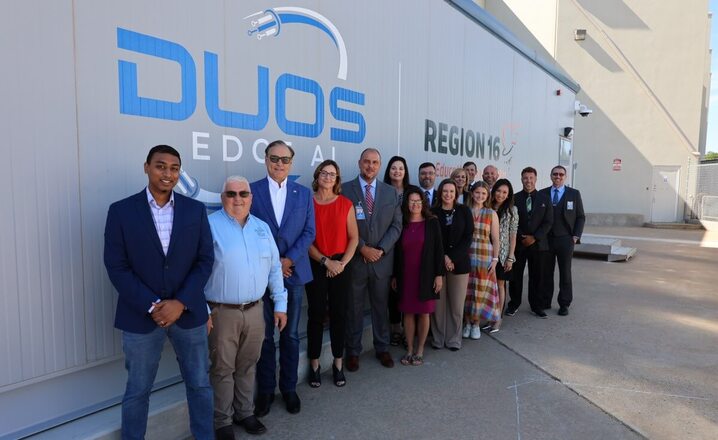
Duos Technologies Group has broadened its edge computing presence in Texas with a new edge data center in Abilene, highlighting the increasing need for localized digital infrastructure to aid education, healthcare, and regional economic growth.
The facility was established through the company’s subsidiary, Duos Edge AI, in partnership with the Region 14 Education Service Center, which supports numerous school districts in West Texas.
The new edge data center in Abilene serves as a carrier-neutral colocation facility and computing hub. By bringing computing and storage resources closer to users, it aims to provide higher bandwidth, secure data processing, and low-latency AI capabilities to over 40 school districts and charter schools across an 11-county area spanning more than 13,000 square miles. This effort addresses connectivity and performance issues in rural and underserved communities that depend on centralized cloud resources located far away.
Duos Technologies Group states that the Abilene deployment is part of a larger strategy to introduce modular, scalable edge infrastructure to areas where digital access has traditionally lagged behind urban centers. By hosting the facility at Region 14 ESC, the partners aim to lower network latency for cloud-based educational platforms, enable AI-driven learning tools, and enhance access to digital services for schools, healthcare providers, workforce development programs, and local businesses.
The project builds on similar edge deployments across Texas, including sites in Amarillo, Waco, and Victoria, each aligned with regional education service centers. These sites reflect a trend toward distributed infrastructure models that focus on proximity, resilience, and cost efficiency over large centralized data centers.
Carrier-Neutral Connectivity
Company leaders have highlighted that the edge data center model offers more than performance improvements. By enabling carrier-neutral connectivity and local data processing, the Abilene facility is intended to support long-term regional innovation and economic growth. Education leaders involved in the project have stressed the importance of equitable access to advanced computing resources, especially as schools increasingly adopt digital curricula, remote collaboration tools, and AI-assisted learning environments.
The Abilene edge data center is expected to be fully operational in early 2026, with a formal launch event planned at the Region 14 ESC headquarters. As edge computing continues to gain momentum across sectors, deployments like this one demonstrate how localized infrastructure can help close digital divides while supporting next-generation applications that require speed, reliability, and data sovereignty.
Executive Insights FAQ
Why are edge data centers gaining momentum in education-focused regions?
They reduce latency, improve reliability, and bring advanced computing closer to schools and institutions with limited access to centralized infrastructure.
What role does carrier-neutral colocation play in this deployment?
Carrier neutrality allows multiple network providers to interconnect, increasing choice, resilience, and competitive pricing for local users.
How does edge infrastructure support AI-driven applications?
By processing data locally, edge facilities enable faster AI inference and analytics while reducing dependence on distant cloud data centers.
What challenges does this model address in rural communities?
It mitigates bandwidth constraints, lowers latency, and improves access to modern digital tools in regions with limited connectivity.
What is the broader significance of Duos Edge AI’s Texas expansion?
It signals a shift toward distributed, regionally focused digital infrastructure aligned with education, healthcare, and economic development needs.